Build Your Own Marketing AI

 May 30,2026
 By SEO ANALYSER
Introduction
In today’s digital-first world, standing out as a marketer requires more than familiarity with standard tools. Custom AI solutions for marketing have become a genuine competitive edge, helping professionals automate campaigns, analyse data with precision, and deliver personalised content at scale. For remote marketers in particular, building or commissioning a tailored AI solution can be the differentiator that demonstrates strategic thinking, technical adaptability, and forward-looking credibility.
This guide walks through the entire journey, from assessing whether a custom AI solution is right for you to choosing development partners, managing implementation, and measuring long-term impact.
Why Marketers Should Consider Custom AI
Generic AI tools have real value, but they are built for the broadest possible audience, which means they are rarely optimised for your specific workflows, data, or commercial goals. A custom AI solution is designed around your needs from the ground up, which produces meaningfully different outcomes.
The core advantages are significant. A tailored model aligns automation directly with your unique objectives rather than forcing you to adapt your processes to a tool’s limitations. It leverages your own proprietary data, whether that is email performance history, customer behaviour patterns, or campaign analytics, to generate insights that generic platforms simply cannot replicate. It scales your workflows without sacrificing quality, and it positions your brand apart from competitors who rely on the same off-the-shelf solutions.
A Sydney-based digital consultant built a custom AI chatbot integrated directly with her client’s CRM system. The result was a 40% faster response rate to inbound leads, which translated directly into higher conversion rates across multiple client accounts.
How to Assess Whether You Need a Custom AI Solution
Clarifying Your Objectives
Before investing in development, you need a precise understanding of what you are trying to achieve. Are you looking to increase organic visibility, generate higher-quality leads, improve customer retention, or reduce the time your team spends on repetitive tasks? Vague goals produce vague outcomes. A clearly defined objective ensures that your AI solution is built around measurable outcomes from the very beginning.
Evaluating Your Data Readiness
Custom AI models are only as good as the data that trains them. Before committing to development, assess your data across three dimensions.
Availability refers to whether you have sufficient volumes of relevant data. This might include email engagement metrics, website performance data, CRM records, ad performance history, or customer feedback. Models trained on thin or narrow datasets tend to underperform and require more frequent retraining.
Cleanliness refers to the quality and consistency of your data. Duplicate records, inconsistent formatting, missing values, and outdated entries all degrade model performance. A data cleaning process before development begins is not optional; it is a prerequisite for reliable results.
Compliance refers to whether your data collection and usage practices meet applicable privacy regulations, including the Australian Privacy Act, GDPR if you serve European audiences, and CCPA if you have Californian customers. Building compliance into your data infrastructure from the outset is far less costly than retrofitting it after a privacy issue arises.
Comparing Your Options Honestly
Off-the-shelf tools carry lower upfront costs and are faster to deploy, making them appropriate for straightforward use cases. Custom AI requires a higher initial investment but delivers tailored functionality, deeper integration with your existing stack, and the ability to evolve alongside your business.
A Melbourne marketing freelancer tested an off-the-shelf content generation tool for several months before switching to a custom AI model trained on her own industry case studies and client data. The improvement in output accuracy was immediate, and her clients responded positively to content that reflected genuine sector expertise rather than generic language patterns.
How to Choose the Right Development Partners
In-House Versus External Expertise
If your organisation has long-term plans to build AI capability as a core function, investing in an in-house team provides continuity and deep institutional knowledge over time. For most marketing professionals and smaller agencies, however, external consultants or specialist development firms offer faster access to relevant expertise without the overhead of permanent hires.
Skills to Look for in a Development Partner
A competent AI development partner for marketing applications needs a specific combination of capabilities. Data science expertise, particularly in machine learning and predictive modelling, is the technical foundation. Marketing knowledge, including an understanding of campaign metrics, customer psychology, and funnel dynamics, ensures that the model is built around commercially meaningful outcomes rather than technical performance metrics alone. Integration skills are equally important; the ability to connect an AI solution with your CRM, email marketing platform, analytics tools, and ad platforms determines whether the solution actually improves your day-to-day workflow.
Vetting Partners Before Committing
Review portfolios and case studies carefully, with particular attention to examples from marketing or adjacent industries. Request a pilot project or proof of concept before signing a full development contract. This gives you a practical basis for evaluating both technical capability and working style. Pay attention to how clearly a potential partner explains technical concepts. Partners who cannot communicate complex ideas in plain language will create friction throughout development and make it harder for your team to interpret and act on the AI’s outputs.
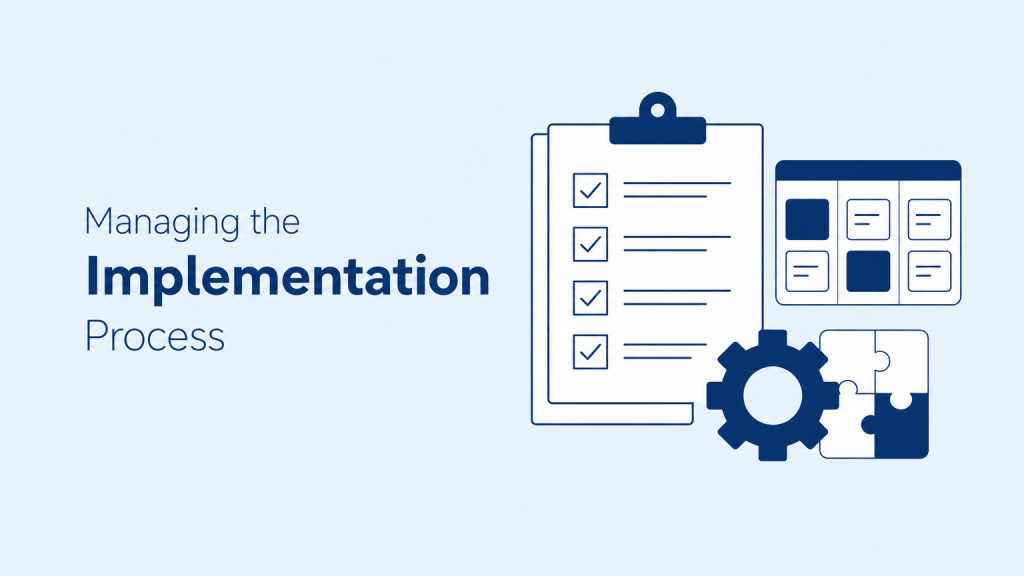
Managing the Implementation Process
Planning and Design
Effective implementation begins with a well-defined scope. Establish which specific marketing functions the AI solution will address, assign clear roles and responsibilities for each stage of development, and identify potential risks early, including data limitations, system compatibility issues, and timeline constraints. Define your KPIs at this stage so that every subsequent development decision can be evaluated against a consistent standard.
Development and Testing
Data preparation is the most time-intensive phase of development and should not be rushed. Clean, label, and structure your datasets before model training begins. Build AI models focused on specific, well-defined tasks such as audience segmentation, campaign optimisation, content personalisation, or lead scoring. Test across a range of scenarios before moving toward deployment, and document the results of each test cycle so that issues can be traced and resolved systematically.
Deployment and Integration
Connecting your AI solution to the rest of your marketing stack is where the practical value is realised. Integration with your CRM, email marketing platform, analytics dashboards, and paid media accounts allows insights to flow through your existing workflows rather than sitting in a separate system that requires manual interpretation. Train your team to read and act on the AI’s outputs confidently. Monitor performance closely during the initial rollout period and be prepared to make rapid adjustments based on real-world behaviour.
A Brisbane agency integrated AI-driven ad targeting with their existing SEO reporting infrastructure after a careful testing phase. The combination of behavioural targeting data and organic search performance insights produced a 25% improvement in ROI across multiple client campaigns within the first quarter of deployment.
How to Measure Success and Scale Responsibly
Defining Meaningful KPIs
The metrics you track should reflect both the operational efficiency gains and the commercial outcomes your AI solution was designed to produce. Relevant KPIs typically include conversion rates and lead quality scores, audience engagement metrics, customer lifetime value, and time saved through automation. Establishing baseline measurements before deployment ensures you have a meaningful comparison point for evaluating impact.
Continuous Optimisation
AI models are not static products. They require regular retraining with fresh data to maintain accuracy as market conditions, customer behaviour, and your own marketing activities evolve. Run A/B tests on AI-driven campaigns to validate assumptions and refine outputs. Collect performance data across platforms to build a comprehensive picture of how the solution is performing relative to your original objectives.
Scaling With Purpose
Once your initial use case is delivering consistent results, expand thoughtfully. Add new applications such as AI-driven email personalisation, predictive audience modelling, or automated performance reporting. Enrich your datasets with new data sources as they become available. At every stage of scaling, maintain clear governance standards. Transparency about how your AI solution uses customer data, and a genuine commitment to ethical practice, builds long-term trust with both clients and audiences.
FAQ
Why choose custom AI over a generic marketing tool?
Generic tools are built for the widest possible audience, which means they are optimised for average use cases rather than your specific workflows, data, or goals. A custom AI solution is designed around your actual business context. It integrates with your existing systems, learns from your proprietary data, and evolves in line with your strategic priorities. The result is more accurate insights, more relevant automation, and outcomes that off-the-shelf platforms are structurally incapable of producing.
Is custom AI realistic for small marketing teams or freelancers?
Yes, provided the approach is appropriately scoped. Starting with a single, well-defined use case, such as AI-driven content recommendations, automated lead scoring, or personalised email sequencing, allows smaller teams to capture meaningful value without overwhelming budgets or development timelines. A focused pilot also provides the evidence base needed to justify further investment over time.
How long does it typically take to build a custom AI solution?
A focused solution addressing a single marketing function can be ready for deployment in six to eight weeks, assuming data is already in reasonable condition. Larger, multi-feature systems that integrate across several platforms and require extensive training data may take three to six months from scoping to launch. Rushing any phase, particularly data preparation and testing, consistently produces worse outcomes and higher remediation costs later.
How do I protect customer privacy when using AI in marketing?
Privacy should be built into the design of your AI solution from the beginning rather than added as an afterthought. Store data securely, obtain clear and explicit user consent for data usage, and document your data governance processes. Ensure compliance with all applicable regulations, including the Australian Privacy Act, GDPR, and CCP, as relevant. Communicating transparently with your audience about how their data is used not only reduces legal risk but also actively builds brand trust.
Will a custom AI solution need ongoing maintenance?
Without exception, yes. AI models degrade in accuracy over time as the underlying patterns in your data shift due to changes in customer behaviour, market conditions, or your own marketing activities. Regular retraining with updated data, ongoing performance monitoring, and periodic reviews of model outputs against KPIs are all necessary to keep a custom AI solution delivering reliable results. Treating AI as an evolving capability rather than a one-time project is the mindset that produces sustained commercial value.
Summary
Artificial intelligence is no longer exclusive to enterprise teams with large budgets. Marketers today can assemble a capable, personalised AI system using accessible tools and a clear understanding of their own workflow needs, without writing a single line of code.
Map the repetitive tasks that consume the most time: content briefs, social captions, email sequences, and performance reporting. Then build your stack in three layers, a content generation tool such as ChatGPT or Claude, an automation layer like Make or Zapier, and a data layer using Notion AI or Google Sheets with AI extensions.
Generic AI output sounds generic. Feed your tools your brand guidelines, tone-of-voice documents, past top-performing content, and audience personas. A reusable system prompt or custom GPT that encodes your brand voice transforms a general-purpose tool into a genuine marketing asset.
Off-the-shelf tools are faster to deploy and carry lower upfront costs, making them suitable for straightforward use cases. Custom AI requires greater initial investment but delivers tailored functionality and deeper integration with your existing stack, and as one Melbourne freelancer discovered, the improvement in output accuracy and client satisfaction makes the switch worthwhile.