Data-Driven Social Media: How Can Analytics Boost ROI?

 May 26,2026
 By SEO ANALYSER
Introduction
Social media activity can look successful while producing very little commercial value. A campaign may generate thousands of impressions, attract new followers, and still fail to deliver qualified traffic, enquiries, or sales. The difference becomes visible only when performance is measured against clear business outcomes.
Social media analytics helps marketers identify which platforms, audiences, formats, and messages contribute to those outcomes. Instead of judging performance by surface-level engagement, teams can examine how social activity influences website visits, lead generation, assisted conversions, and customer acquisition costs.
This shift matters because publishing more content does not automatically improve performance. A data-driven approach helps businesses invest in the activity that produces useful results and reduce spending on content that attracts attention without supporting the customer journey.
Social platforms also play a growing role in online discovery. People use them to research products, compare businesses, and find answers. Analysing this behaviour can strengthen social campaigns while providing useful insights for search, landing pages, and wider content planning.
Why Social Media Analytics Matters
Analytics turns social media from a collection of isolated posts into a measurable marketing system. It shows what happened after content was published and helps explain why one campaign performed differently from another.
The value does not come from collecting the largest possible volume of data. It comes from connecting the right data to a defined objective. If the goal is lead generation, follower growth alone provides limited insight. Click quality, landing page behaviour, completed forms, and acquisition costs offer a clearer view of performance.
Analytics can also reveal differences between apparent popularity and commercial influence. A highly polished brand post may generate substantial reach but few meaningful actions. A smaller educational post may attract fewer viewers while producing more qualified visits and conversions.
This matters because budgets often move towards visible activity. Without deeper analysis, teams may continue supporting posts that look impressive in reports but contribute little to revenue or customer acquisition.
A practical measurement hierarchy
| Measurement level | Useful metrics | What it explains |
|---|---|---|
| Visibility | Reach, impressions, video views | Whether the intended audience had an opportunity to see the content |
| Engagement quality | Saves, shares, comments, completion rate | Whether the content attracted attention or provided enough value to prompt a response |
| Traffic | Link clicks, click-through rate, website sessions | Whether users moved from the social platform to an owned digital channel |
| Commercial contribution | Leads, purchases, assisted conversions, acquisition cost | Whether social activity contributed to a meaningful business outcome |
Choose Metrics That Match the Objective
No single metric can explain the complete value of a social media campaign. The appropriate measurement depends on what the content was designed to achieve and where it sits in the customer journey.
Awareness content may reasonably be assessed through qualified reach, video completion, profile visits, and branded interest. Consideration content should encourage deeper engagement, website visits, saves, or repeat interaction. Conversion-focused content needs to be evaluated through leads, sales, assisted conversions, and cost efficiency.
Problems arise when a metric is separated from its purpose. A low click-through rate may not indicate failure if a video was designed to build familiarity. In contrast, high reach is not enough to validate a campaign intended to generate enquiries.
Before publishing, teams should define:
- The intended audience for the post or campaign
- The stage of the customer journey the content supports
- The primary action the audience should take
- The metric that best represents that action
- The business outcome connected to the metric
This structure keeps reporting focused. It also makes campaign comparisons more reliable because success is assessed against the original purpose rather than whichever number appears strongest afterwards.
Read Content Performance Signals in Context
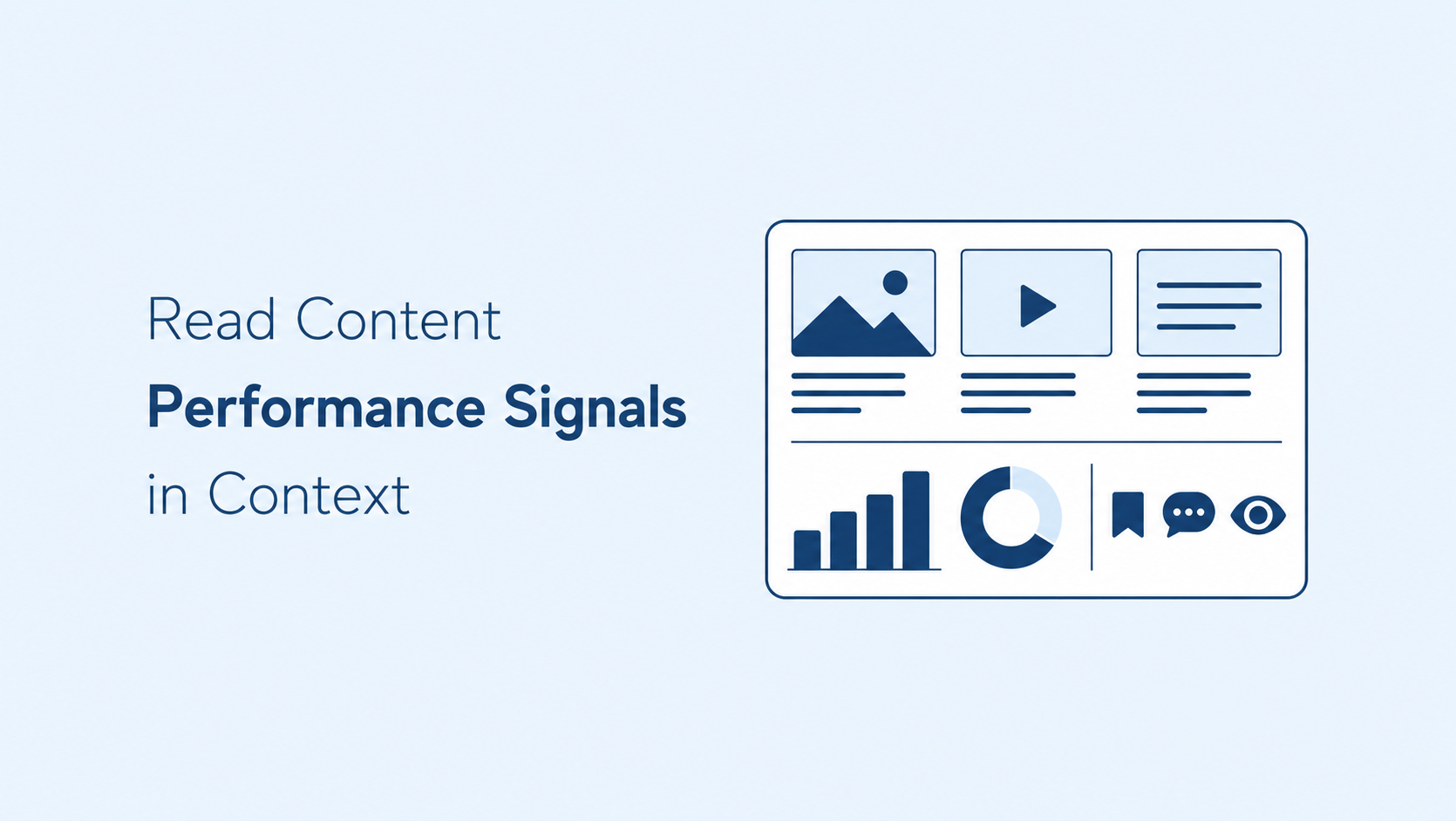
Content-level data can show whether an audience merely noticed a post or found it useful. Shares, saves, thoughtful comments, completion rates, profile visits, and clicks often provide more context than likes alone.
A single successful post may be an exception. Repeated patterns are more useful. If educational carousels consistently generate saves and qualified traffic, the evidence points to sustained audience interest in that format. If short videos produce strong reach but limited website activity, they may be better suited to awareness than conversion.
That does not mean one format is better in every situation. Different formats can perform different roles within the same campaign. Video may introduce the topic, a carousel may explain it, and a conversion-focused post may direct users to a relevant landing page.
Useful content analysis should compare:
- Format, including video, carousel, static image, and text-led posts
- Topic and message
- Audience segment
- Publishing time and frequency
- Organic and paid distribution
- Call to action
- Landing page performance after the click
These comparisons help teams separate content problems from distribution or conversion problems. A post may attract the right audience but send visitors to a weak landing page. In that case, changing the creative alone is unlikely to improve ROI.
Use Audience Data to Improve Targeting
Audience analytics can replace broad assumptions with evidence about who is responding and how different groups behave. Platform data may reveal location, device use, viewing habits, interests, and engagement patterns. Website analytics can then show what happens after those users leave the platform.
Segmentation is important because followers are not a single audience. Some people are discovering the brand for the first time. Others are comparing options, looking for practical information, or preparing to make a purchase.
Reviewing all users as one group can hide useful patterns. A campaign may appear average overall while performing strongly among a commercially valuable segment. That finding can guide future targeting, creative decisions, and budget allocation.
Audience insights can also support other channels. Common questions and recurring pain points can inform website copy, email content, landing pages, remarketing campaigns, and search-led articles. The value of social analytics therefore extends beyond the platform where the data was collected.
Connect Social Data with Search Behaviour
Social and search provide different views of audience demand. Social data reflects immediate reactions, emerging conversations, and format preferences. Search behaviour reflects the questions people continue to investigate with stronger intent.
When these signals are examined together, they can improve content planning. A topic that repeatedly attracts saves, comments, and profile visits may justify deeper coverage through a guide, service page, or search-focused resource.
Social performance should not be treated as direct proof of search demand. A popular post may depend on timing, presentation, or platform culture. However, it can provide an early indication that a subject deserves further keyword research and audience validation.
The connection also works in the opposite direction. Search queries can reveal the language customers use, which can improve social captions, video scripts, and campaign themes. This creates a feedback loop in which each channel contributes evidence to the other.
Turn Analytics into Better ROI
Data improves ROI only when it changes a decision. Reports that are produced and filed away may describe performance, but they do not improve it.
An effective review process should identify:
- Which content reached the intended audience
- Which interactions indicated genuine interest
- Which posts generated qualified website activity
- Which campaigns influenced leads, purchases, or assisted conversions
- Where users stopped progressing through the journey
- Which activity should receive more, less, or no further investment
Teams should also compare performance across a meaningful period. Daily fluctuations can create noise, while monthly or campaign-level reviews make recurring patterns easier to identify. Active campaigns may still need weekly checks so obvious problems can be corrected before they consume more budget.
Testing should focus on one meaningful variable at a time where possible. Changing the audience, format, message, timing, and landing page together makes it difficult to identify what caused the result. A more controlled approach produces findings that can be applied to future campaigns.
Over time, small improvements can compound. Better targeting reduces irrelevant reach. Stronger creative increases useful engagement. More relevant landing pages improve conversion potential. Clearer attribution helps budgets move towards the channels and campaigns that make the strongest commercial contribution.
FAQs
Summary
A data-driven social media strategy connects content activity with audience behaviour and commercial outcomes. Reach and engagement remain useful, but they become more meaningful when analysed alongside qualified traffic, conversions, acquisition costs, and the role each post plays in the customer journey.
The strongest gains come from disciplined review. By comparing formats, audiences, channels, and downstream behaviour, businesses can reduce low-value activity and invest more confidently in the work that improves marketing ROI.