How to Do Keyword Research That Drives Traffic

 Jul 21,2026
 By SEO ANALYSER
Most keyword lists I review for client accounts have the same problem. Someone picked twenty keywords based on what sounded right, added them to a spreadsheet, and never checked whether anyone was actually searching for them. The keywords looked reasonable. They just didn't match what people were typing into Google.
This matters because keyword research isn't really about finding words. It's about finding the language your audience already uses, then building content that answers what they need. An SEO analyser can speed up that process, but only if you understand what the data is telling you and why. This guide walks through a practical approach to keyword research that's grounded in search behaviour, not guesswork, and explains where tools genuinely help versus where judgement still matters.
Why Most Keyword Research Misses the Mark
The usual mistake isn't a lack of keywords. It's choosing keywords that don't match what the searcher actually wants. A page can rank for a term and still get almost no clicks, because the content doesn't satisfy the intent behind the search.
Search volume gets treated as the main decision factor, when it's really just one input among several. A keyword with modest monthly searches but strong buyer intent can bring in more enquiries than a high-volume term that attracts browsers rather than buyers. Worth noting here: the goal isn't more traffic for its own sake, it's traffic that converts or engages in a way that supports the business.
Match Keywords to Search Intent Before You Pick Any Tool
Before opening any keyword tool, it helps to sort search queries into intent categories. This sets the frame for every decision that follows, including which pages to build and what format they should take.
The table below shows the four broad intent types most searches fall into, along with what a searcher usually expects to find.
| Intent type | What the searcher wants | Typical content format |
|---|---|---|
| Informational | An answer or explanation | Blog post, guide, FAQ |
| Navigational | A specific website or brand | Homepage, branded landing page |
| Commercial | Comparisons before deciding | Comparison page, review, "best of" list |
| Transactional | To buy, book, or sign up | Product page, service page, pricing page |
To put that in context, ranking a blog post for a transactional keyword rarely works well. The searcher wants to buy, not read a guide. Matching content format to search intent early avoids building pages that rank but underperform on clicks and conversions.
What an SEO Analyser Actually Shows You About Keyword Opportunity
This is where an SEO analyser earns its place in the workflow, and it's worth explaining exactly what it does and doesn't do. A good analyser pulls together search volume, keyword difficulty, and ranking data for terms you're already targeting, then flags gaps between what you rank for and what your competitors rank for. That combination is more useful than any single metric viewed alone.
Consider a mid-size Melbourne home services business ranking on page two for "emergency plumber Melbourne", a competitive, high-intent term. Running that domain through an SEO analyser might surface three signals at once:
- 1The keyword carries strong buyer intent, so ranking well would attract people ready to book.
- 2The current page lacks depth compared to the competitors ranking above it.
- 3Several related long-tail variations, like "24 hour plumber inner Melbourne", have almost no competition.
Acting on the volume figure alone would push the business to keep chasing the competitive term. Acting on the full picture points somewhere more useful: strengthen the existing page and build supporting pages around the lower-competition variations first.
That's the real value of running keyword research through an analyser rather than relying on a single number. Difficulty scores estimate how hard a term is to rank for based on the strength of pages currently ranking, but they're an estimate, not a guarantee. Results can vary depending on your site's existing authority, technical health, and how well the content matches search intent once it's published. Treat the score as a filter for prioritisation, not a promise of where you'll land.
Use a Keyword Tool to Expand Your Seed List
Once intent is mapped, a keyword tool helps expand a small seed list into a fuller picture of related terms, questions, and phrasing variations. Start with three or four core terms tied to your main service or product, then let the tool surface variations, related searches, and question-based queries built around those seeds.
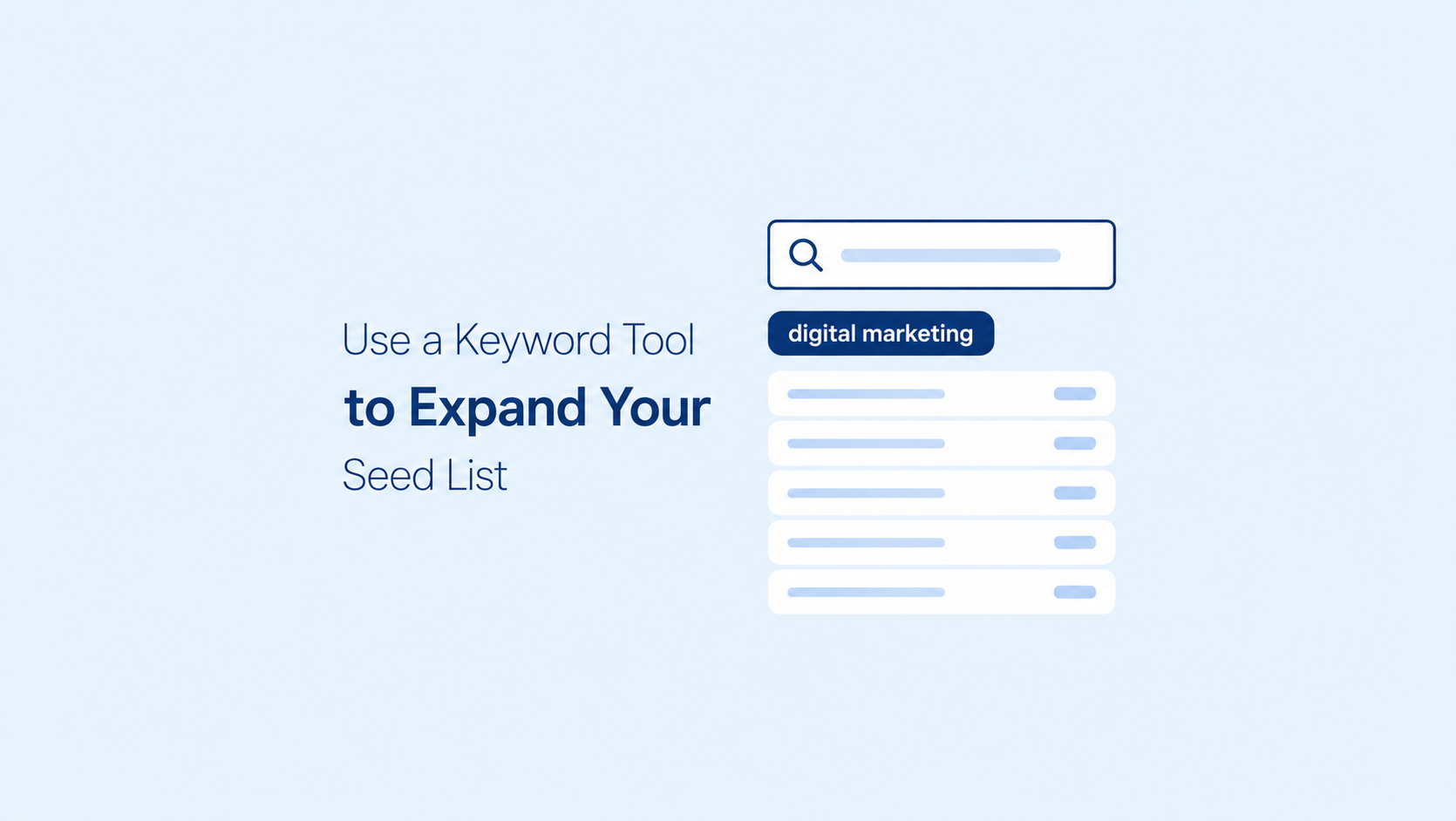
The output from most keyword tools is broader than what you'll actually use. Filtering matters as much as generating the list. Remove terms with unclear intent, near-duplicates of terms you already rank for, and anything too generic to realistically compete for. What's left should be a shorter, sharper list tied to specific pages or content pieces, rather than a loose collection of loosely related phrases sitting in a spreadsheet unused.
Prioritise Long-Tail Keywords for Faster Wins
Broad, high-volume terms are tempting because the numbers look impressive, but they're usually the slowest path to results for smaller or newer sites. Long-tail keywords, the longer, more specific phrases searchers use when they know roughly what they want, tend to carry lower competition and clearer intent.
"SEO"
Broad and hard to interpret. High competition and unclear intent make it a slow climb for smaller sites.
"how to check keyword difficulty before publishing a blog post"
Tells you almost exactly what the searcher needs and what content will satisfy them.
A search for "SEO" is broad and hard to interpret. A search for "how to check keyword difficulty before publishing a blog post" tells you almost exactly what the searcher needs and what content will satisfy them. That specificity translates into a stronger click-through rate on the pages that target it well, because the content promise matches the search precisely. Building a base of long-tail content first, then layering broader terms on top once the site has established some ranking signals, tends to produce steadier growth than chasing competitive terms from day one.
Check for Keyword Overlap Across Pages
Before publishing anything new, check whether an existing page already targets the same or a very similar keyword. This step gets skipped often, and it's a quick one to build into any workflow.
Keyword overlap creates a problem search engines sometimes call cannibalisation, where two pages on the same site compete against each other for the same query. Instead of one strong page, the site ends up with two weaker ones splitting relevance and links. An SEO analyser can flag this by showing which pages currently rank for a given term, which makes the check faster than manually searching site by site.
Where AI SEO Analysis Fits Into Keyword Research
AI SEO analysis tools have become common for spotting patterns across large keyword sets, grouping related terms into topic clusters, and suggesting content angles based on what's already ranking. Used well, this speeds up the early research stages considerably, particularly for sites with hundreds of potential keyword targets to sort through.
That said, your mileage may vary depending on how the tool was trained and how specific your industry is. Automated suggestions still need a human check against actual business goals and audience knowledge. A tool can tell you that a keyword cluster exists; it can't tell you whether your business genuinely has the expertise or product range to serve that intent credibly. Treat AI-assisted grouping as a starting point for research, not a final decision on what to publish.
Turning Keyword Research into a Content Plan
Once keywords are grouped by intent and filtered for overlap, the next step is mapping them to specific pages rather than leaving them as an unattached list. Each core topic usually needs one primary page targeting the main term, supported by a handful of related pages covering long-tail variations and adjacent questions.
This structure, often called a content plan built around topic clusters, helps search engines understand how pages on a site relate to each other. It also gives internal linking a clear logic: supporting pages link back to the main page, and the main page links out to relevant supporting content. Research indicates that this kind of structured approach tends to perform more consistently over time than publishing disconnected pages targeting whatever keyword seemed interesting that week.
Common Keyword Research Mistakes to Avoid
A few mistakes show up repeatedly across accounts, regardless of industry or site size:
- Choosing keywords by search volume alone, without checking intent
- Skipping the check for existing pages already targeting the same term
- Ignoring long-tail variations in favour of only competitive head terms
- Treating a keyword tool's suggestions as final decisions rather than a starting point
- Publishing content without mapping it to a specific page or cluster first
Each of these is fixable with a short process check before publishing, rather than a full strategy overhaul.
FAQ
Summary
Keyword research that drives traffic starts with intent, not volume. Sorting terms by what the searcher actually wants, then checking for overlap across existing pages, prevents the two most common causes of wasted effort: content that ranks but doesn't convert, and pages competing against each other for the same query. An SEO analyser supports this process by surfacing difficulty scores, overlap issues, and gaps in the current keyword footprint, but the decisions about what to prioritise still rest on judgement built from understanding the audience.
Long-tail keywords remain one of the more reliable paths to steadier growth, particularly for sites still building authority. Combined with a clear content plan grouped around topic clusters, this approach tends to produce more consistent results than chasing high-volume terms in isolation. The tools speed up the process considerably. The strategy behind them is still what determines whether the traffic that follows is worth having.