

Why AI Cites Some Businesses and Ignores Others

 Jul 20,2026
 By SEO ANALYSER
You've spent months getting your website to rank on Google. Then a customer mentions they found a competitor through ChatGPT instead, and your business wasn't even in the answer. Sound familiar?
It's happening to small business owners across Australia right now, and it's not because your SEO (search engine optimisation, the process of helping your website show up on Google) is doing anything wrong. It's because AI tools answer questions differently to a normal Google search, and most websites simply weren't built with that in mind.
This guide explains what answer engine optimisation actually means, why some businesses get quoted by AI search engines while others get ignored, and what you can start doing about it today, without hiring an agency or learning to code.
What Is Answer Engine Optimisation?
Answer engine optimisation is the practice of setting up your website so AI tools can find your content, understand it quickly, and quote it directly when answering someone's question. That's a different goal to traditional SEO, which mostly focuses on getting a link onto page one of Google.
Think of traditional SEO like getting your shop listed in the phone book. People still have to find the listing, then call you themselves. Answer engine optimisation is more like training the person behind the counter to recommend your shop by name the moment someone asks where to find what you sell. The AI is that person behind the counter, and it's deciding which businesses deserve a mention.
This matters because AI citations (when an AI tool names your business directly in its answer) are becoming a real source of enquiries for small businesses, not just a nice-to-have.
Why AI Search Is Changing the Way Customers Find You
More people are typing full questions into AI chat tools instead of searching Google and clicking through a list of links. Instead of "plumber Fremantle," someone might type "who's a reliable plumber near Fremantle that does emergency callouts?" The AI tries to answer that directly.
That shift matters because the old goal, ranking near the top of a search results page (the list of results you see after searching), isn't the whole picture anymore. Google's own AI Overviews now sit above those results and summarise answers before anyone scrolls down.
Here's the good news: this isn't a closed club. Small, well-organised websites can get quoted by AI tools just as easily as big brands, sometimes more easily, because AI looks for clear answers rather than size or budget.
How AI Search Engines Decide What to Cite
This is really the heart of the whole topic, so let's slow down here. AI search tools are usually built on large language models (the underlying AI systems trained to understand and generate written language). When someone asks a question, the AI doesn't just guess. It pulls together information from pages it has already read and understood, then builds an answer, often naming the source it used.
The AI tends to favour pages that give structured, clear answers early, rather than pages that bury the answer under a long story. If your page opens with three paragraphs about your business history before ever answering the question someone asked, an AI is more likely to skip past it and quote a competitor who answered plainly in the first line.
Here's a simple comparison. Imagine two local bakeries write a page titled "Do you make gluten-free bread?" The first bakery opens with a sentence: "Yes, we bake fresh gluten-free bread daily, available in-store and for local delivery." The second bakery opens with three paragraphs about the history of the family recipe before mentioning gluten-free options at all, buried in the fourth paragraph.
An AI tool asked "which bakery near me does gluten-free bread?" is far more likely to quote the first bakery. Not because their bread is better, but because their page made the answer easy to lift and use. AI tools also tend to check whether a claim is backed up elsewhere on the site or repeated consistently across pages, which affects how confident they are quoting you directly.
This doesn't mean storytelling has no place on your website. It just means the direct answer should come first, with the extra detail and personality afterwards.
Answer Engine Optimisation vs Traditional SEO
These two approaches overlap a lot, but they're not identical. A short comparison makes the difference clearer.
| Aspect | Traditional SEO | Answer Engine Optimisation |
|---|---|---|
| Main goal | Rank near the top of Google's results | Get quoted directly inside an AI answer |
| Content style | Keyword-focused, can be longer and broader | Direct answers first, supporting detail after |
| Success measure | Clicks and ranking position | Mentions and citations inside AI answers |
| What builds it | Backlinks, page speed, keyword targeting | Clarity, structure, and consistent domain trust (how much AI and search engines trust your website overall) |
You don't need to choose one over the other. Most of the habits that help with traditional SEO, like having a fast, well-organised website, also support answer engine optimisation. The main change is writing with the direct answer up front, every time.
How to Structure Content So AI Can Read and Quote It
Don't worry if this sounds technical, it's really about writing habits more than code. AI tools favour pages that are easy to scan and easy to pull a clean sentence from. A few habits make a genuine difference here.
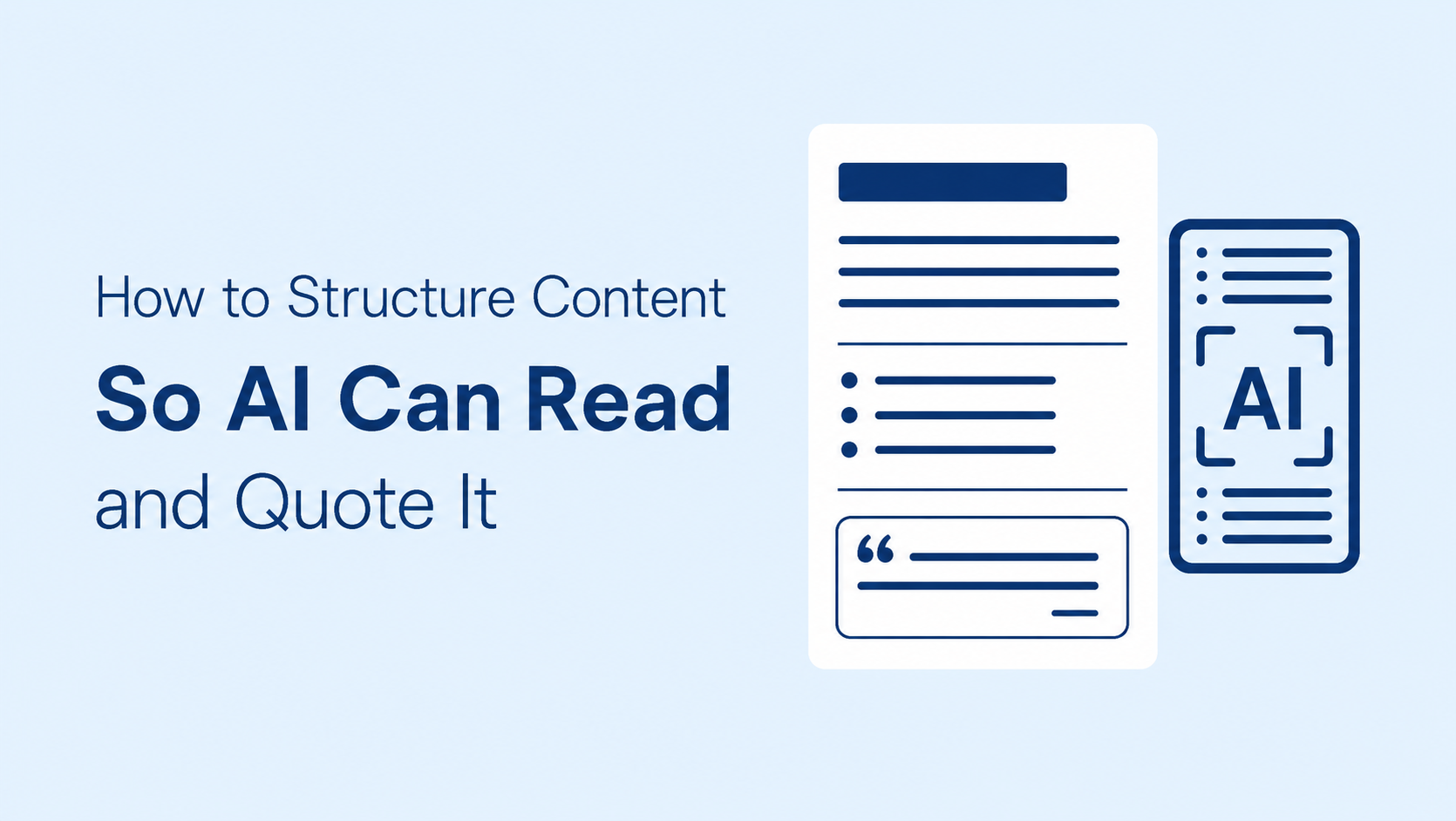
- Answer the main question in the first one or two sentences of the page or section
- Use clear headings that match the actual questions your customers ask
- Keep paragraphs short, ideally two to four sentences
- Use simple structured data (a bit of code that tells search engines exactly what your content is about, like a business address or opening hours) where it applies to your page
- Write concise definitions for any terms your customers might not know
Getting Your Site Indexed by AI Tools
Before an AI can quote your business, it needs to have found and read your site in the first place. This is called AI indexing, and it works a bit differently to how Google has always crawled websites.
Most AI tools still rely on your site being accessible, fast, and free of technical blockers, so many of the basics you'd already check for Google still apply here. Making sure your site loads properly and your pages aren't blocked from being read is still the starting point, even for AI-specific visibility.
Building the Trust Signals AI Looks For
AI tools, like search engines before them, are cautious about quoting a business they're not confident in. Backlinks (other trusted websites linking to yours) still matter here. Think of it like word-of-mouth. The more genuinely trusted sites that mention or link to you, the more confidence an AI tool has in citing you as a source.
Consistency matters too. If your business details, service descriptions, and contact information match across your website, your Google Business Profile, and any directories you're listed in, that consistency acts as a quiet form of proof. These trust signals don't guarantee a citation, but they make one far more likely over time.
Common Mistakes That Stop AI From Citing Your Business
A few habits quietly work against businesses trying to get noticed by AI tools. Burying the answer to a common question deep inside a long page is one of the biggest, since AI tools often skip past pages where the point isn't obvious early on. Letting old information sit unchanged for years is another, since content freshness (how recently a page has been reviewed or updated) can affect how confident an AI is in relying on it. Vague, generic pages that could describe almost any business in that industry also tend to get passed over in favour of ones with specific, local detail.
How to Tell If Answer Engine Optimisation Is Working
There's no single dashboard that shows every AI mention yet, so this takes a bit of manual checking rather than one automatic report. The simplest method is to search your own common customer questions inside tools like ChatGPT or Perplexity every so often and see whether your business appears in the answer.
Keeping an eye on referral traffic from AI tools inside your website analytics can also give you a rough sense of whether people are arriving after reading an AI answer that mentioned you. It's not perfect, but it's a genuine starting point for tracking your progress.
FAQs
Summary
Answer engine optimisation isn't about throwing out everything you've already learned about SEO. It's about adjusting how you write, so AI search engines can find your content, trust it, and quote it directly when someone asks a question your business can genuinely answer. Clear structure, honest answers up front, and consistent details across your website all play a part.
You don't need a technical background or a big marketing budget to start. Pick a handful of the questions your customers ask most often, answer them plainly at the top of the page, and keep your business details consistent everywhere you appear online. That's a solid, realistic starting point for answer engine optimisation, and it's one you can genuinely manage yourself.


