SEO ANALYSER: The Complete Search Intelligence Platform

 Jun 23,2026
 By SEO ANALYSER
Introduction:
Last updated: June 2026
Written by: Sarah Jones
The rules of search are changing fast. Traditional ranking metrics like backlinks and site speed are still critical. However, the way search engines present information is fundamentally different now.
Many SEO professionals report that managing a modern search campaign requires too many disconnected tools. You might use one app to find keywords, another to run technical diagnostics, and a third to draft your content. This fragmented approach wastes time and budget. It also leaves blind spots in your strategy.
We built SEOANALYSER to solve this exact problem. It brings all these workflows into one unified workspace. It is an all-in-one search intelligence platform designed not just to track your data, but to actively help you improve it.
The shift to Generative Engine Optimisation (GEO) means search engines now synthesise answers directly. If your toolkit was built ten years ago, it is blind to these new AI ranking signals. This guide explains exactly who this platform is for, the specific tools it provides, and why it exists. We will show you how to apply it to streamline your daily workflow.
Before diving into the detailed features, here is a clear look at how SEOANALYSER stacks up against legacy platforms. This table focuses on the integration of modern AI capabilities alongside traditional SEO tools.
| Core Features | SEOANALYSER | SE Ranking | Moz | Ahrefs |
|---|---|---|---|---|
| Keyword Research & Analysis | ✓ | ✓ | ✓ | ✓ |
| Technical Website Audits | ✓ | ✓ | ✓ | ✓ |
| Local SEO Tracking | ✓ | ✓ | ✓ | - |
| AI Search Visibility Tracking | ✓ | - | - | - |
| AI-Assisted Issue Resolution | ✓ | - | - | - |
| Integrated AI Content Creator | ✓ | - | - | - |
| Comprehensive Free Audits | ✓ | - | - | - |
| LLMs.txt Validation | ✓ | - | - | - |
Tracking Your AI Visibility
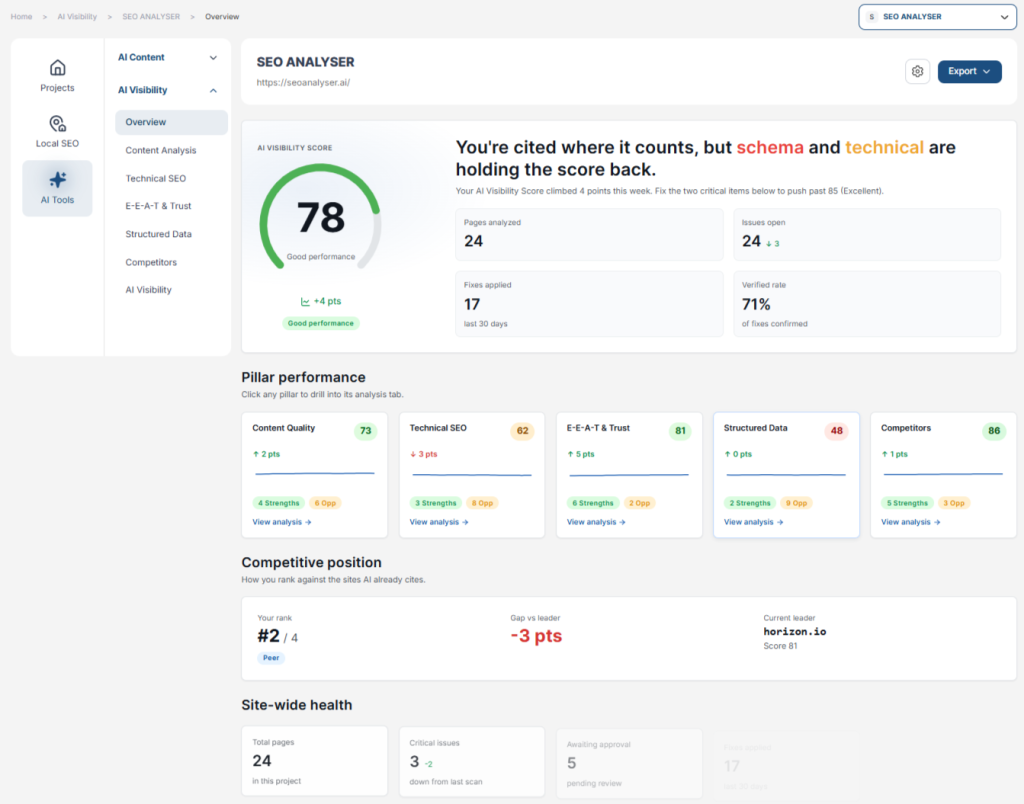
Search engines now use generative AI to answer user queries directly. Tracking standard blue links only tells half the story. You must know if AI models are using your content as a source.
SEOANALYSER introduces dedicated AI visibility tracking. This feature monitors up to six different AI engines, including ChatGPT, Perplexity, and Gemini. It scans generative engine summaries to see if your brand is being cited. Without this data, you are flying blind in the modern search landscape.
How to check AI visibility in the dashboard
Understanding your share of voice in AI summaries is crucial. The tool evaluates your citation-readiness and entity clarity. This ensures large language models clearly understand your brand and recommend it properly.
Step 1: Open the GEO Dashboard
Navigate to the AI Tracking tab in the main menu.
Why it matters:This dedicated view separates traditional organic traffic from new AI-driven referrals.
Step 2: Enter your target queries
Input the main questions your customers ask.
Why it matters:AI engines respond best to conversational queries rather than fragmented keywords.
Step 3: Review citation rates
The tool will display how often your domain is cited within the AI-generated answers.
Why it matters:A high ranking means nothing if the AI engine answers the user's question using a competitor's data.
Pro tip:Don't just look at your traditional ranking position. Monitor your "Citation Rate" to see how often AI engines actually pull data from your paragraphs to form their answers.
Measuring Entity Clarity and Brand Authority
Generative engines do not read websites like traditional web crawlers do. They rely heavily on entity clarity. This means the AI must clearly understand who you are, what you sell, and why you are an authority.
SEOANALYSER breaks down how AI evaluates your website’s declarative content. It shows you exactly where your content is ambiguous. It then suggests plain-English rewrites to help the AI map your brand to specific industry topics. If you fix these trust gaps, your discoverability across conversational AI assistants will increase significantly.
Conducting Foundational Keyword Research
Knowing the exact words your target audience types is the bedrock of search strategy. SEOANALYSER provides comprehensive keyword research data to guide your campaigns and identify traffic gaps.
Our platform does more than just report search volume. It finds high-intent keyword ideas to grow your organic reach. It also tracks your position across global and local markets, ensuring you never miss a sudden trend or traffic spike.
How to find high-intent keywords
Beyond raw numbers, the platform maps search terms to specific user intent. It also helps discover specific content gaps that are preventing your site from earning AI citations. This ensures you focus on queries that bring buyers, not just browsers.
Step 1: Use the Keyword Explorer
Type in a broad seed topic related to your industry.
Why it matters:Broad topics give the engine room to find hundreds of related long-tail variations.
Step 2: Filter by Intent
Use the drop-down menu to isolate "Transactional" or "Commercial" queries.
Why it matters:Informational traffic is great for brand awareness, but transactional traffic pays the bills.
Step 3: Analyse keyword difficulty
Choose terms where the competition metric is low enough for your domain authority.
Why it matters:Targeting keywords that are too competitive wastes your marketing budget.
Common mistake:Chasing high-volume vanity keywords. A keyword with 50 searches a month that clearly shows intent to buy is far more valuable than a vague keyword with 5,000 searches.
Spotting Market Research Trends
Search behaviour changes constantly. Our market research module surfaces what your audience is searching for next. This allows your content and product teams to stay ahead of the curve. By spotting rising topics early, you can align your content roadmap with actual demand signals. This reduces the guesswork and ensures your publishing schedule is driven entirely by data.
Diagnosing Technical Issues
A website with broken links, slow pages, or bad indexation settings will struggle to rank. Our crawler conducts thorough website audits, checking over 70 technical factors to find structural errors.
Technical SEO forms the foundation of your website. If a search bot cannot crawl your site, nothing else matters. Our tool analyses page speed, mobile optimisation, meta tags, and SSL security. It then prioritises the fix list so you know exactly where to start.
How to fix website audits using AI
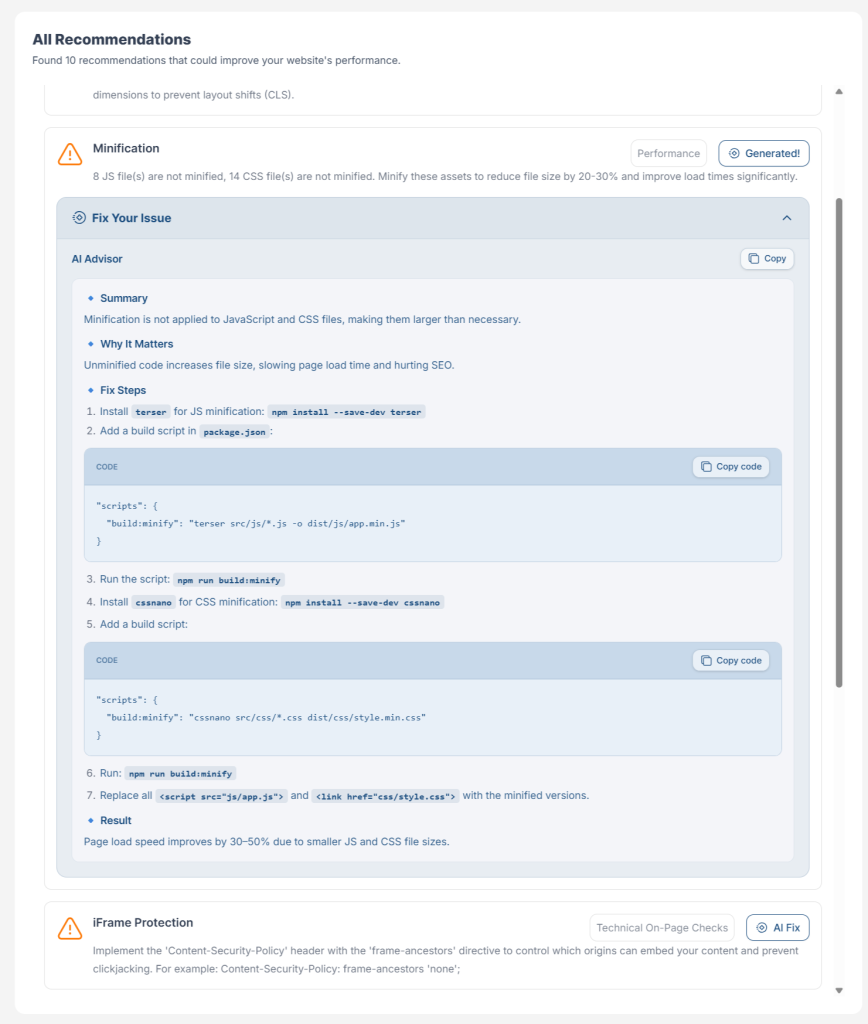
Most tools just give you an intimidating list of warnings. SEOANALYSER goes further by using AI to help you fix the problems. It checks crucial AI-specific signals, such as your robots.txt access for AI crawlers.
Step 1: Run a full site crawl
Enter your URL and let the engine scan your architecture.
Why it matters:Regular crawls catch hidden issues like 404 errors before they impact your traffic.
Step 2: Review critical errors
Look for the high-priority red flags, such as redirect loops or missing titles.
Why it matters:Fixing critical errors provides the fastest boost to your overall site health score.
Step 3: Click "AI Resolve"
The platform will analyse the specific error and generate plain-English instructions.
Why it matters:It bridges the gap between identifying a problem and actually solving it.
Pro tip:Hand the AI-generated code snippets directly to your web developer. It saves them hours of diagnostic work and prevents them from having to guess the correct syntax.
Validating Schema and AI Readiness
An AI SEO tool that actually works needs to audit entirely different signals than a traditional tool. We evaluate your FAQ page schema to ensure it is valid and mapped to real user questions. We also check your HowTo schema to ensure your instructional content is structured correctly.
Furthermore, we validate your llms.txt file. This plain text file is becoming the standard way to feed your site’s core information directly to large language models. If this file is missing or formatted poorly, we provide a generator to build it for you in seconds.
Streamlining Workflows with the AI Content Creator
Moving from keyword analysis to content writing usually causes friction. Marketers often have to open entirely different applications to draft the copy, which slows down production.
SEOANALYSER eliminates this problem. It embeds an AI content creator directly inside the SEO workspace. You can execute your strategy without leaving the dashboard. This creates a seamless pipeline from data discovery directly into content production.
How to write copy that ranks
The built-in assistant helps you break through writer's block and create high-quality content fast. It ensures your drafts hit the required semantic terms for both human readers and search algorithms.
Step 1: Select a target keyword
Choose a keyword from your research list to base your article around.
Why it matters:Starting with data ensures your article actually has an audience waiting to read it.
Step 2: Generate a content brief
The AI will analyse the top 10 ranking pages and build a structure.
Why it matters:It shows you exactly what headings and topics Google currently rewards.
Step 3: Draft and refine
Use the AI to write sections, integrating secondary keywords naturally.
Why it matters:The AI helps you cover all semantic bases, proving your topical authority to search engines.
Common mistake:Letting AI write the whole article without human review. Always edit the output to ensure it matches your specific brand voice and local Australian context.
Humanising Content
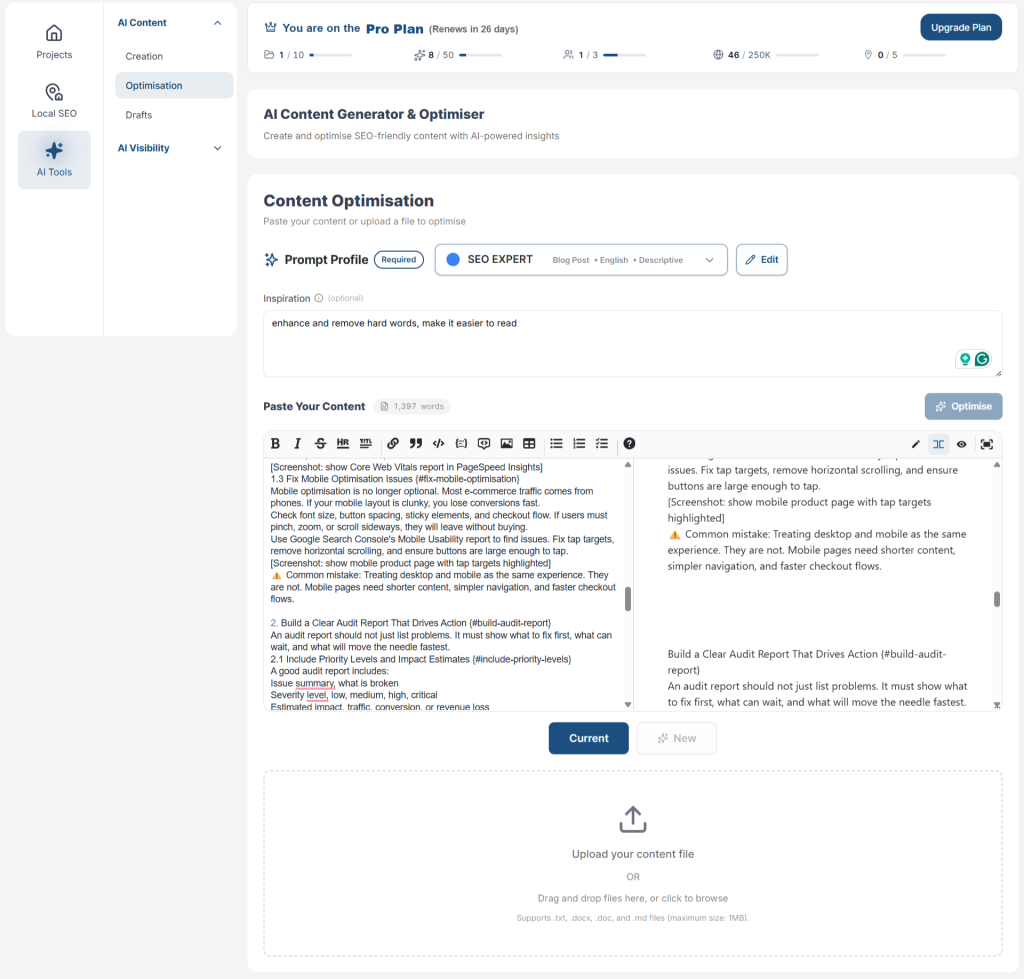
Search engines penalise mass-produced, robotic content. Our platform includes a feature to humanise your drafts. It bridges AI-assisted drafting with a natural, trustworthy voice.
The tool identifies robotic patterns and suggests edits to tune readability and authenticity. This is critical for both human readers and model evaluation. By smoothing out the repetitive phrasing typical of basic AI models, you can publish confidently across all your marketing channels.
Managing Local SEO
For businesses relying on physical foot traffic, national visibility matters less than dominating a specific suburb. Our local SEO toolset manages geographic search signals.
Local search is highly competitive. Whether you run a single store or manage fifty locations, you need a unified view of your local presence. Our platform tracks your Google Business Profile, local directories, and location-based AI queries to ensure your doors stay open.
How to track local rankings
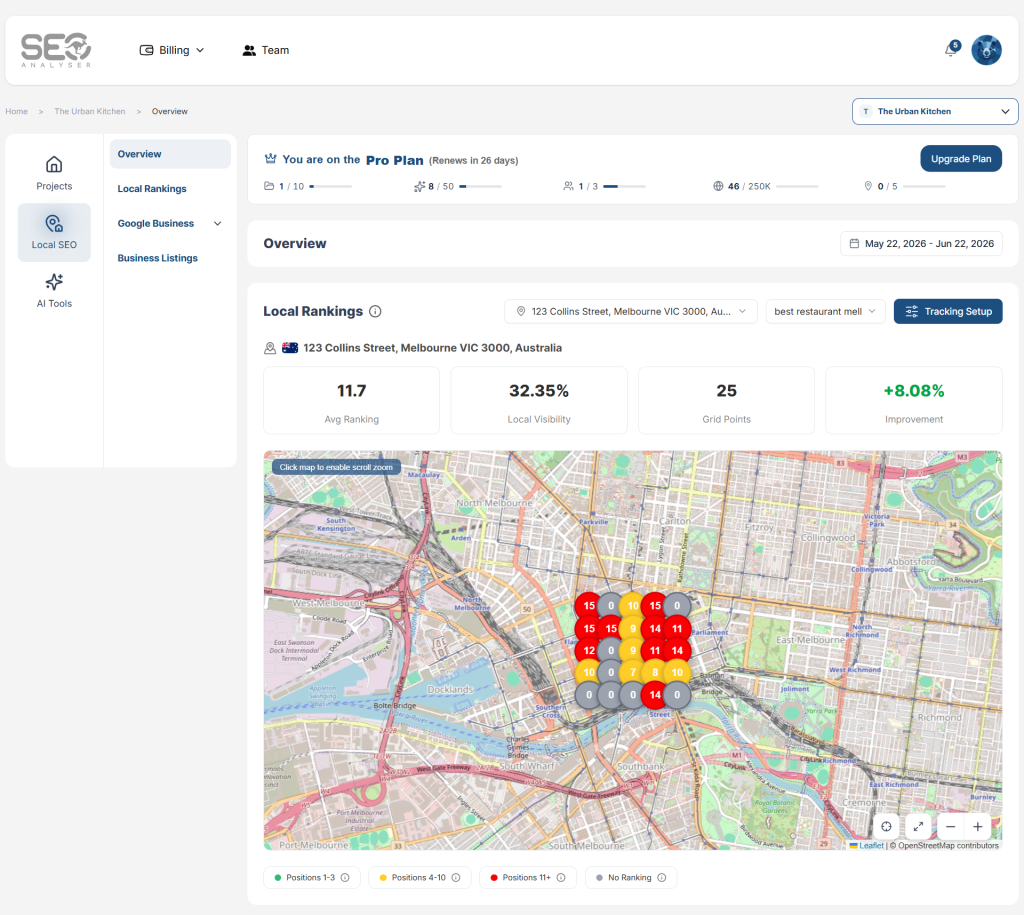
The platform provides geo-targeted tracking so you can see exactly how you perform across different postcodes.
Step 1: Set your target location
Enter your exact business address and define a search radius.
Why it matters:Rankings change drastically from one street to the next in densely populated cities.
Step 2: View the local grid
The tool shows your ranking position changing block-by-block across a map.
Why it matters:It visually highlights exactly which neighbourhoods you are losing to competitors.
Step 3: Monitor citations
Ensure your business name, address, and phone number are consistent.
Why it matters:Inconsistent details confuse search engines and damage your local trust score.
Pro tip:If your map pack rankings drop in a specific suburb, focus on gaining local backlinks or customer reviews that specifically mention that area.
Managing Reviews and Brand Sentiment
Your reputation is a major local ranking factor. Our platform includes an AI-driven review analysis tool. It extracts themes, risks, and opportunities from customer feedback.
The AI classifies sentiment and helps you understand the main drivers behind your reviews. It even sends alerts for negative feedback so you can respond quickly. By keeping your local reputation clean, you send strong trust signals back to the main search algorithms.
Getting Started with Free Audits
We believe software should prove its worth before you pay for it. That is why we offer comprehensive free audits straight from our homepage.
You do not need to create an account or provide a credit card to see the value. The tool gives you a fast, honest read on how AI engines and search crawlers see your brand.
How to run a baseline scan
You can get an immediate snapshot of your website's health in under ten seconds.
Step 1: Enter your URL on the homepage
Paste the link to your most important page.
Why it matters:It initiates a 13-category deep scan covering meta tags, accessibility, and Core Web Vitals.
Step 2: Wait for the diagnostic scan
The engine will perform a rapid check of your technical setup.
Why it matters:It checks your server security, HTTPS headers, and mobile responsiveness.
Step 3: Review the baseline report
You will see your primary blockers and overall score immediately.
Why it matters:You get a prioritised fix list so you know exactly what to change first.
SEO ANALYSER or SEO ANALYZER?
Whether you spell it SEOAnalyser or SEOAnalyzer, the tools work the same way.
The platform is engineered as a complete search intelligence ecosystem. It brings keyword research, technical website audits, local tracking, and an AI content creator into one dashboard. By connecting the discovery of issues to the execution of fixes, SEOANALYSER provides practical utility for modern web optimisation.
Why We Are the Best
Many legacy platforms simply attach an “AI marketing badge” to their outdated traditional tools. They might add a basic text generator, but their underlying infrastructure remains the same. SEOANALYSER is completely different. We built this platform specifically to bridge the gap into the generative search era.
We stand out because we actively audit the deep technical signals that determine whether AI engines will cite your content. We verify AI crawler access, check your llms.txt file, and evaluate your true citation-readiness.
Instead of just scoring your website’s past performance, we act as an AI optimisation engine. We provide the exact fixes and prompts needed to improve your discoverability across modern LLMs and search platforms. We combine AI visibility insights with an elite traditional SEO suite, ensuring you never have to guess what is holding your traffic back.