

AI SEO Assistant: What It Is and What It Should Do

 Oct 09,2026
 By SEO ANALYSER
AI SEO tools guide
An AI SEO Assistant is a connected assistant that reads your site's search and traffic data, then turns it into a prioritised list of what to fix. Here's what the category actually covers, and where it fits into a real SEO workflow.
Short answer
An AI SEO Assistant is a connected assistant, not a chatbot
An AI SEO Assistant is a feature built into an SEO platform that connects to your actual data sources, typically Google Search Console, GA4, and a site crawl, then uses a language model to interpret that data and produce plain-language findings, prioritised to-do lists, and step-by-step guidance. It differs from a general-purpose chatbot because it works from your site's real numbers rather than general SEO knowledge, and it should require human approval before it changes anything on the live site.
Definition
What is an AI SEO Assistant?
The term covers a growing category of features across SEO platforms: an in-app assistant that a marketer can ask questions of, in plain language, and get answers grounded in that specific site's connected data rather than generic advice. Instead of "how do I fix a slow page," the useful version answers "why did organic clicks drop on my pricing page last month," using the property's own Search Console and GA4 data to work it out. Vendors describe the same idea under several names, an AI SEO advisor, a conversational SEO assistant, or simply natural language SEO analysis, but the mechanics are the same: connect the data, ask the question in plain English, get an answer that points back to the evidence.
That distinction, connected versus generic, is what separates the category from simply asking a general AI assistant SEO questions. A general assistant can explain what a canonical tag is. It cannot tell you which canonical is live on your homepage right now, because it has no access to your site.
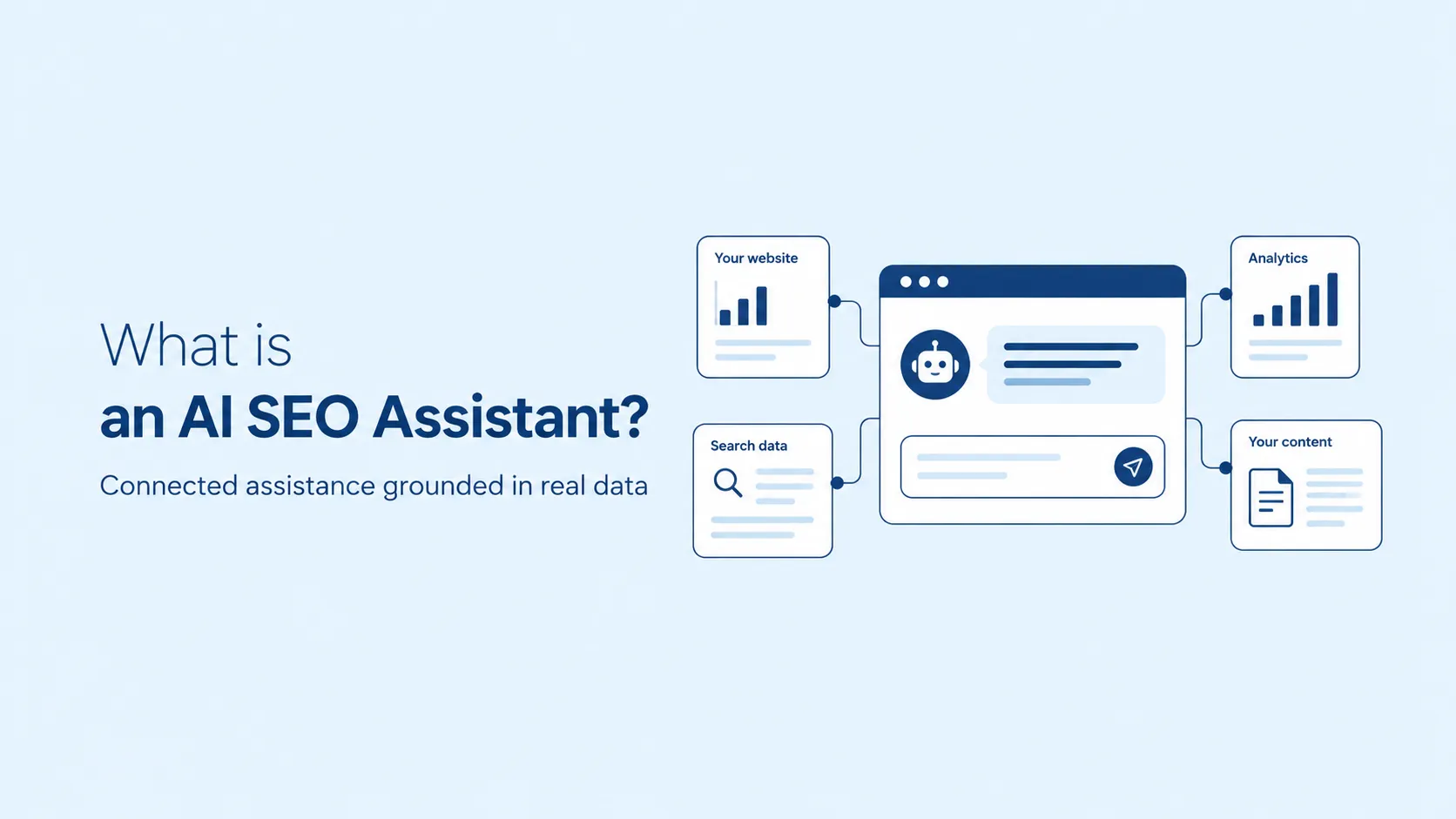
Some tools take a different route to the same connection: rather than building the assistant into the platform, they expose an MCP server so you can bring your own AI, chatting with your Search Console data from inside Claude or ChatGPT instead of a dedicated dashboard. Both approaches solve the same underlying problem; the difference is where the conversation happens.
Use cases
Where an AI SEO Assistant actually helps
The category earns its keep on the recurring, evidence-heavy questions that would otherwise mean opening three or four separate reports:
- 01
Diagnosing a traffic drop
Cross-references Search Console impressions and clicks with GA4 sessions and conversions to narrow a decline down to a specific set of queries, pages, or a technical cause, instead of one vague "traffic is down" alert.
- 02
Turning an audit into a to-do list
Takes the raw output of a technical crawl, hundreds of individual checks, and reorders it into a short, prioritised list based on likely impact, so the team fixes the handful of issues that matter first.
- 03
Explaining a ranking change
Connects a position shift for a specific keyword to the page, content change, or competing result most likely responsible, with the underlying data attached so the explanation can be checked, not just trusted.
- 04
Surfacing content and keyword gaps
Compares what a site already ranks for against related demand it is missing, and suggests where new or updated content would close the gap.
- 05
Drafting a plain-language client or stakeholder report
Summarises what changed, why it likely changed, and what is being done about it, in language a non-specialist can follow, without losing the underlying numbers.
Capabilities
Capabilities worth checking for
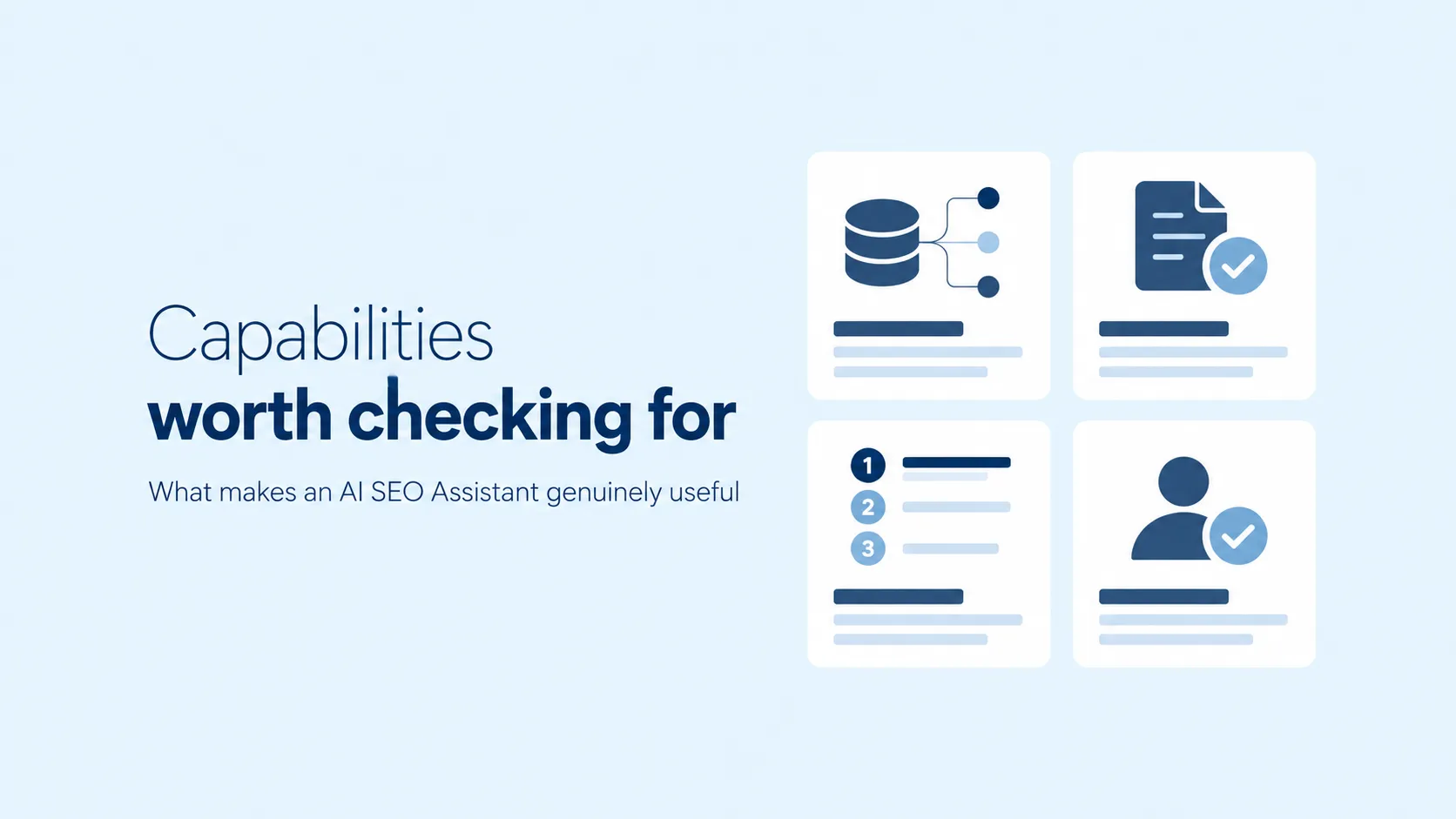
Not every feature marketed as an "AI SEO Assistant" does the same job. These are the capabilities that separate a genuinely useful one from a wrapper around a generic chatbot:
Direct data connections
Connects to Google Search Console and GA4 (and ideally a crawl and any local or AI-visibility data) rather than relying on the user to paste numbers in manually.
Sourced recommendations
States which data source, property, and date range support a given finding, so a recommendation can be checked rather than taken on faith.
Prioritisation, not just reporting
Turns a long list of findings into an ordered set of next actions based on likely impact, rather than leaving the user to work out what matters most.
Human approval on changes
Keeps the person in control of anything that touches the live site, structured data, or a Google Business Profile, rather than auto-publishing changes.
Limits
What an AI SEO Assistant can't do
It can accelerate analysis and organise findings, but it cannot guarantee a ranking, a traffic number, or inclusion in an AI-generated answer, because search engines and AI platforms, not the assistant, control those outcomes. It also cannot replace strategic judgement: prioritising between a technical fix and a content investment, or deciding what a brand should and shouldn't say, still needs a person. Treat a confident-sounding explanation as a hypothesis until the underlying page, query, or report has actually been checked.
SEO Analyser
How SEO Analyser's AI Assistant approaches this
AI Assistant connects directly to a project's Google Search Console and GA4 data, alongside SEO Analyser's own Website Audit, Local SEO, and AI Visibility findings, so it can answer questions grounded in that site's actual performance rather than general SEO knowledge. Ask it about a specific SEO problem and it explains what the data shows, then turns the findings into a prioritised, plain-language to-do list the team can act on directly.
Explore AI AssistantFrequently asked questions
AI SEO Assistant FAQs
Is an AI SEO Assistant the same as ChatGPT with an SEO prompt?
No. A general assistant can explain SEO concepts from training data. A connected AI SEO Assistant reads a specific site's actual Search Console, GA4, and crawl data before answering, which is why its answers can be checked against real numbers.
Can it replace an SEO specialist?
No. It can organise data, surface patterns, and draft prioritised actions, but strategy, risk assessment, and final implementation decisions still need a person.
Does using an AI SEO Assistant guarantee better rankings?
No. Rankings are controlled by search engines, not by any assistant. Treat a guarantee of specific ranking outcomes as a warning sign in any product's marketing.
What should it connect to first?
Search Console for search performance is the common starting point; GA4 adds on-site behaviour and conversion context once that is connected.
Is this different from GA4's built-in Ask Advisor or Gemini?
Yes, in scope rather than quality. GA4's Ask Advisor answers questions from on-site analytics data, sessions, events, and conversions, but it cannot see Search Console queries, impressions, or ranking positions. An AI SEO Assistant that connects both sources can join the two: which query drove the session, and what it converted to.
Summary
Judge the category by data connections and traceable reasoning, not by the word "AI." A useful AI SEO Assistant reads a site's own Search Console, GA4, and crawl data, explains its evidence, and turns findings into a prioritised, human-approved to-do list. Anything less is a chatbot with an SEO skin.
References
Sources and further reading
- SEO AnalyserAI SEO Assistant: Turn Search Data into Prioritised Actions
- SEO AnalyserTraffic Analytics
- SEO AnalyserWebsite Audit
- GoogleSearch Analytics API reference (Search Console)
- GoogleGoogle Analytics 4 developer documentation
- GoogleAsk Advisor in Google Analytics (Beta)
- Model Context ProtocolOfficial MCP specification and documentation


