

How Does SEO Analyser Calculate the AI Visibility Score?

 Oct 07,2026
 By SEO ANALYSER
Product methodology
SEO Analyser's 0 to 100 AI Visibility Score combines four graded website pillars with live mention, citation, position and tone data from monitored AI engines.
Short answer
What does the AI Visibility Score mean?
SEO Analyser's AI Visibility Score answers one question: when someone asks an AI system what the best option is, or asks about a brand by name, does that brand show up, and how well? The score is not a single standalone check. It rolls up four graded pillars, Content Quality, Technical SEO, E-E-A-T & Trust and Structured Data, plus the brand's live citation performance, measured by running a set of approved questions across several AI engines and checking every answer for mention, citation, position and tone. AI Visibility is the output layer built from those pillars and that live data, not a fifth pillar counted alongside them. It is a product methodology benchmarked against the project's own tracked competitors and questions. It is not a Google metric and not an industry-wide standard.
A different job
This is a methodology page, not another measurement guide
Our guide to measuring AI visibility explains the broader practice: choosing questions, checking AI platforms, and recording mentions, citations and competitors by hand. The guide to checking a business in AI search turns that practice into a workflow a business owner can run without the product.
This page has a narrower purpose. It explains exactly what the SEO Analyser AI Visibility Score measures, how the four checks and the graded pillars feed it, and where interpretation should stop. To see the product itself before reading the methodology, start with the AI Visibility feature overview.
The process
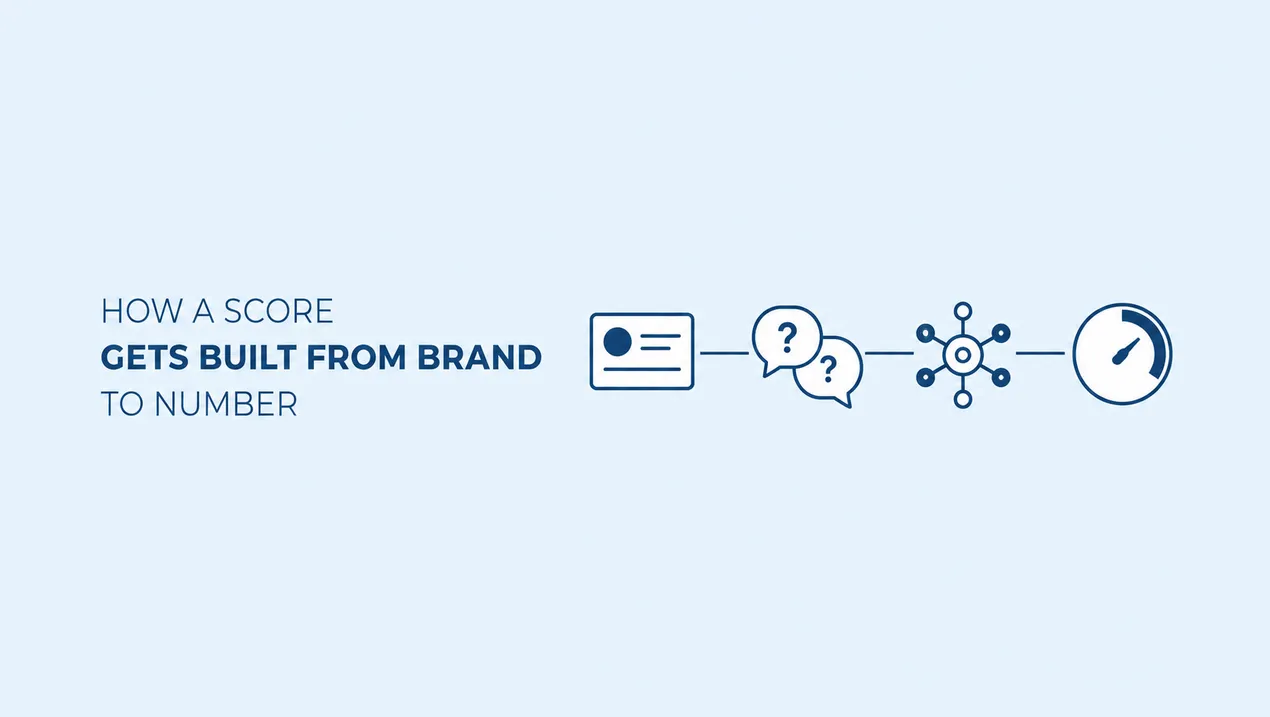
How a score gets built, from brand to number
The score starts with a brand and a topic, and ends with a set of rates calculated across every answer collected. Four stages sit in between.
Brand and questions are prepared
You set up a project with the brand name, website and topic. The system then drafts around ten candidate questions: roughly half are suggestive, asking for the best option in the category without naming the brand, and half are brand-named, asking directly whether the brand is good for that topic. Near-duplicate questions are removed, and you approve the final list before anything is measured.
The same questions go to several AI engines
Every approved question is sent to each monitored engine, currently ChatGPT, Claude, Perplexity, Google's AI Overview summaries and Grok. The logic is similar to a local geo-grid rank tracker, except each point on the grid is an AI engine rather than a location on a map. One question sent to one engine produces one answer to check.
Four checks run on every answer
Each answer is checked for mention, citation, position within any list, and tone. The checks are described in full in the next section.
Rates are calculated across all answers
Once every question has been asked of every engine, the results are turned into rates: what share of answers mentioned the brand, what share cited the brand's own site, the average position when listed, and how the mentions read in tone. These rates can be viewed overall, by engine, and by question type.
The 0 to 100 score is the summary layer. The question-by-question, engine-by-engine breakdown is the evidence behind it.
The four checks
What is actually checked in each answer?
Every answer collected goes through the same four checks, in the same order, to build the live citation-performance signal that feeds into the AI Visibility Score. A brand cannot score on citation, position or tone in an answer where it was never mentioned in the first place.
| Check | Counts as a match | Does not count |
|---|---|---|
| Mention | The brand name, a known alternative name, or the site's domain appears anywhere in the answer text. | The brand appearing only in the question itself, not in the answer. |
| Citation | The brand is mentioned and the answer also links to the brand's own website. | The brand is named but the answer links to someone else's site, or does not link at all. |
| Position | The brand appears inside a numbered or ordered list of options, and its place in that list is recorded. | A mention that sits outside any list. It still counts as a mention, just not for position. |
| Tone | Only checked where the brand is mentioned: positive language nearby, negative language nearby, or neither. | An answer where the brand is never mentioned. That answer is left out of the tone calculation rather than marked negative. |
These four checks combine into the live citation-performance signal. That signal is one of the inputs to the AI Visibility Score, alongside the four graded pillars covered next.
How the score is built
Four graded pillars, plus live citation performance
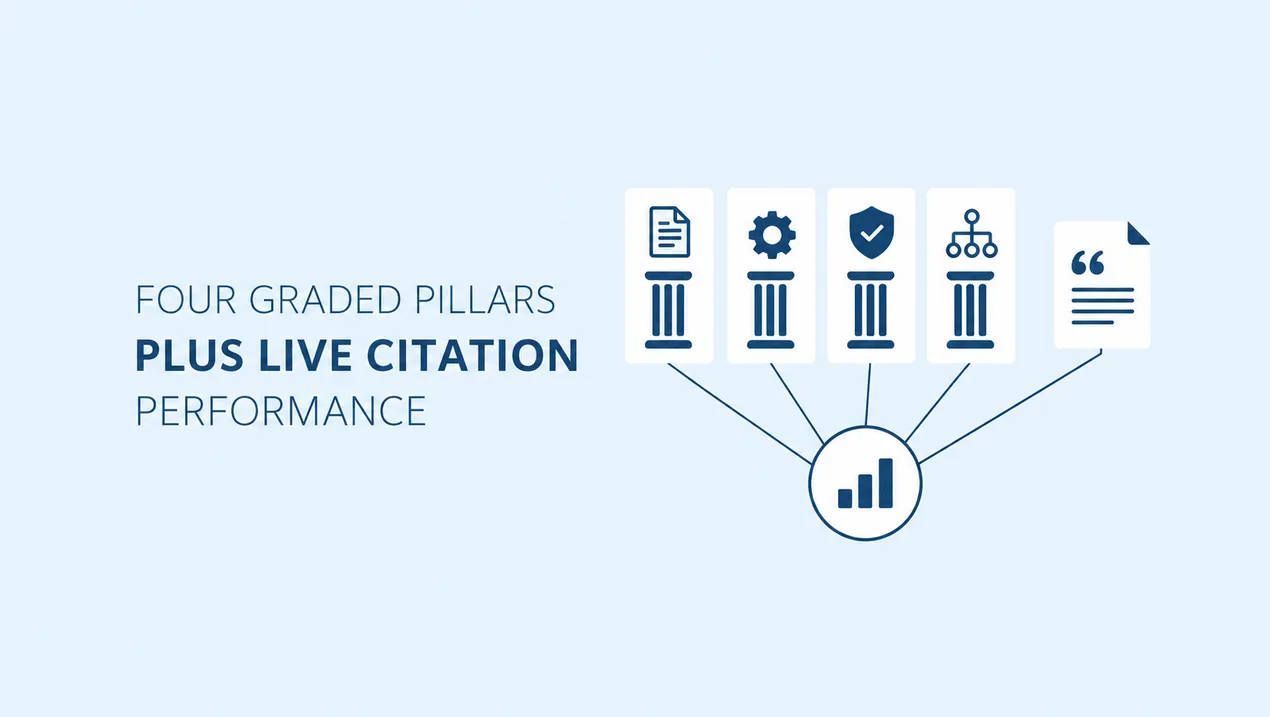
The AI Visibility Score is not a black box. It rolls up four graded pillars, assessed from the website itself, together with the live citation-performance signal described above. AI Visibility is the output layer that combines these, not a fifth pillar counted alongside them.
Content Quality
Is the page clear, useful and relevant to the questions it should answer?
Graded pillar Assessed from the website's own content, independently of any AI engine.
Technical SEO
Can crawlers and engines actually access and read the page?
Graded pillar Assessed from the website's own technical setup, independently of any AI engine.
E-E-A-T & Trust
How credible are the authorship, authority and trust signals around the site?
Graded pillar Assessed from the website's own trust and authority signals.
Structured Data
Is the page's information clear enough for machines to read?
Graded pillar Assessed from the website's own markup and data structure.
Live citation performance is the fifth input: the mention, citation, position and tone checks, run across the monitored questions and AI engines. Together, the four graded pillars and live citation performance roll up into the single 0 to 100 AI Visibility Score.
Worked example
Reading a result end to end
A brand sells accounting software. Ten questions were approved, five engines were monitored, giving fifty answers in total.
Read together, this means the AI systems being monitored know the brand and name it fairly often, but rarely treat its own website as the source worth linking to. It is visible without yet being the default reference point. If the brand also scored poorly on suggestive questions but well on brand-named questions, that gap has a specific meaning: the AI knows the brand when asked about it directly, but does not yet volunteer it when someone simply asks for the best option in the category.
The bigger picture
Where AI Visibility sits inside the overall project score
AI Visibility is not a fifth, independent layer added on top of the graded pillars. It is the output layer: the same four graded pillars below combine with the brand's live citation performance to produce the AI Visibility Score itself. SEO Analyser's overall project score is built from these four graded pillars, so AI-answer performance and website health are never confused with each other.
| Graded pillar | What it asks |
|---|---|
| Content Quality | Is the page clear, useful and relevant to the questions it should answer? |
| Technical SEO | Can crawlers and engines actually access and read the page? |
| E-E-A-T & Trust | How credible are the authorship, authority and trust signals around the site? |
| Structured Data | Is the page's information clear enough for machines to read? |
Putting it together
The logic, in six steps
-
01
Define the brand and topic
Set the domain, the category, and the competitors used for comparison.
-
02
Generate and approve questions
Draft roughly ten suggestive and brand-named questions, remove near-duplicates, and approve the final list before monitoring starts.
-
03
Ask the same questions across engines
Send every approved question to each monitored AI engine to collect one answer per question-engine pair.
-
04
Check every answer
Run the mention, citation, position and tone checks on each answer collected.
-
05
Calculate the rates
Turn the checks into mention rate, citation rate, average position and tone distribution, viewable overall, by engine and by question type.
-
06
Combine into one score
Combine the four rates into the live citation-performance signal, then roll that signal up together with the four graded pillars, Content Quality, Technical SEO, E-E-A-T & Trust and Structured Data, into the 0 to 100 AI Visibility Score, the output layer rather than a fifth pillar.
Reading the result
How should you interpret a 0 to 100 AI Visibility Score?
Read the score as a comparative summary inside the project, not a universal grade. It becomes useful once it is paired with the same question set, the engine-by-engine breakdown, and a trend over time.
Use it for direction
Track whether mention, citation, position and tone are strengthening, weakening or holding steady across comparable runs.
Open the breakdown
Check which of the four checks moved, and whether the change came from suggestive questions, brand-named questions, or one specific engine.
Compare like with like
Keep the domain, question set, engine selection and competitors consistent when judging a trend.
Allow for run-to-run variation
AI answers change between runs, so judge a movement across several comparable runs rather than a single one.
| What you see | What to inspect | A careful conclusion |
|---|---|---|
| Mention rate rises, citation rate flat | Which answers now mention the brand, and whether any of them also link to it. | The brand is being talked about more, but is not yet treated as the source worth linking to. |
| Strong on brand-named questions, weak on suggestive ones | The suggestive question set and the categories it covers. | AI systems recognise the brand when asked directly, but do not yet volunteer it as a recommendation. |
| One engine improves, others do not | The question-level answers on that specific engine. | The gain is engine-specific unless the other engines show a similar pattern. |
| Score falls after the question set changes | Which questions were added or removed, and why. | The baseline changed. Treat the new total as a new comparison point, not a continuation of the old series. |
| Brand beats a tracked competitor | Both brands across the same questions and engines. | The brand leads inside this project's benchmark, not necessarily across the whole category. |
Fair comparison
What needs to stay consistent?
AI-generated answers can vary between runs, and project setup affects what gets measured. Keep the following consistent when comparing scores over time:
- Question set: use the same approved questions, and record any deliberate additions, removals or wording changes.
- Engine set: compare runs across the same monitored AI engines.
- Competitor set: note when a competitor is added, removed or replaced.
- Brand and domain rules: keep naming, alternative names and domain attribution consistent.
- Time window: use comparable dates, since answers can shift between runs.
- Market context: keep language, location and category assumptions stable where they affect a question.
If one of these conditions changes, note the date. The score can still be useful, but it becomes a new baseline rather than a clean continuation of the old one.
Methodology limits
What the AI Visibility Score cannot tell you on its own
Responsible interpretation matters as much as the score itself. These limits stop the summary number from being read as more than the monitored questions and engines can support.
It is not a universal industry standard
The 0 to 100 score belongs to SEO Analyser's methodology. It should not be assumed to match a score from another tool.
It represents a defined sample
The result reflects the approved questions, engines and competitors in this project, not every possible question someone could ask.
AI answers can vary between runs
The same question can get a different answer on a different day. A trend across several comparable runs is more informative than one snapshot.
It does not prove causation
A score change after a website update is an observation. Confirm the question, engine and timing evidence before concluding that the change caused the result.
It is not a traffic or revenue metric
Visibility in AI answers can support discovery, but the score does not replace GA4 conversion data, Search Console performance or commercial reporting.
The total can hide engine-level differences
Always check the per-engine breakdown. A strong result on one engine can sit alongside weak or absent visibility on another.
From score to work
What should you do after reviewing the score?
Use the score to decide where to look, then use the four-check breakdown to choose the work. A sensible review sequence is:
Find the check that moved Identify whether mention, citation, position or tone changed the most.
Open the evidence Read the specific answers behind that change, by question and by engine.
Choose a relevant fix A weak mention rate points at content and topical coverage. A weak citation rate points at how citable and linkable the page is.
Verify the change Confirm the update went live and did not introduce a new technical problem.
Re-check the same setup Compare a later run using the same questions, engines and competitors.
For site-level technical evidence, use a website audit. For questions that combine AI visibility with GA4, Search Console, Google Business Profile and crawl data, the AI SEO assistant guide explains the wider decision workflow.
See the evidence behind the number
Review mention, citation, position and tone by question and engine
SEO Analyser keeps the 0 to 100 summary connected to every underlying answer, so you can see exactly which questions and engines are driving the score.
Explore AI VisibilityFrequently asked questions
AI Visibility Score FAQs
What is an AI Visibility Score?
It is a 0 to 100 output that rolls up four graded pillars, Content Quality, Technical SEO, E-E-A-T & Trust and Structured Data, together with the brand's live citation performance, measured by asking approved questions across several AI engines and checking every answer for mention, citation, position and tone.
How is the SEO Analyser AI Visibility Score calculated?
Every collected answer is checked for mention, citation, position and tone. Those four rates combine into a live citation-performance signal. That signal then rolls up together with four graded pillars, Content Quality, Technical SEO, E-E-A-T & Trust and Structured Data, into the single 0 to 100 AI Visibility Score. AI Visibility is the output layer, not a fifth pillar counted alongside the four it draws on.
Does the score penalise a brand for not being mentioned in an answer?
Not directly through tone. An answer with no mention lowers the mention rate, which lowers the live citation-performance signal, but it is excluded from the tone calculation rather than counted as negative. Being invisible and being spoken about negatively are tracked as separate outcomes.
What is the difference between a mention and a citation?
A mention is the brand name, an alternative name or the domain appearing anywhere in the answer text. A citation requires that plus a link to the brand's own website in that same answer. A brand can be mentioned often while rarely being cited.
Is the score the same as an AI search ranking?
No. AI answers do not produce one universal ranking position across every engine and question. The score summarises a set of monitored questions and answers, and the per-question, per-engine breakdown shows exactly where the brand was mentioned, cited or listed.
Does a higher score guarantee more traffic or sales?
No. A higher score means stronger performance within the monitored questions and engines. Traffic and commercial outcomes still need to be checked separately using GA4, Search Console and business reporting.
How does the AI Visibility Score relate to the overall project score?
AI Visibility is not a fifth layer alongside the graded pillars. It is the output layer: the overall project score is built from four graded pillars, Content Quality, Technical SEO, E-E-A-T & Trust and Structured Data, and those same pillars combine with live citation performance to produce the AI Visibility Score itself. A strong AI Visibility Score cannot complete the overall project score on its own if the underlying pillars are weak.
Summary
SEO Analyser's AI Visibility Score is a 0 to 100 output that rolls up four graded pillars, Content Quality, Technical SEO, E-E-A-T & Trust and Structured Data, together with the brand's live citation performance, built from four checks, mention, citation, position and tone, run across every answer collected from a set of approved questions asked on several AI engines. AI Visibility is the output layer built from those same graded pillars, not a fifth pillar counted alongside them, so it should be read together with the graded pillars rather than in isolation, and never treated as a guarantee of traffic, sales or search ranking.


