Keep, Consolidate, or Delete? The SEO Decision That Can Protect Your Rankings

 Oct 02,2026
 By SEO ANALYSER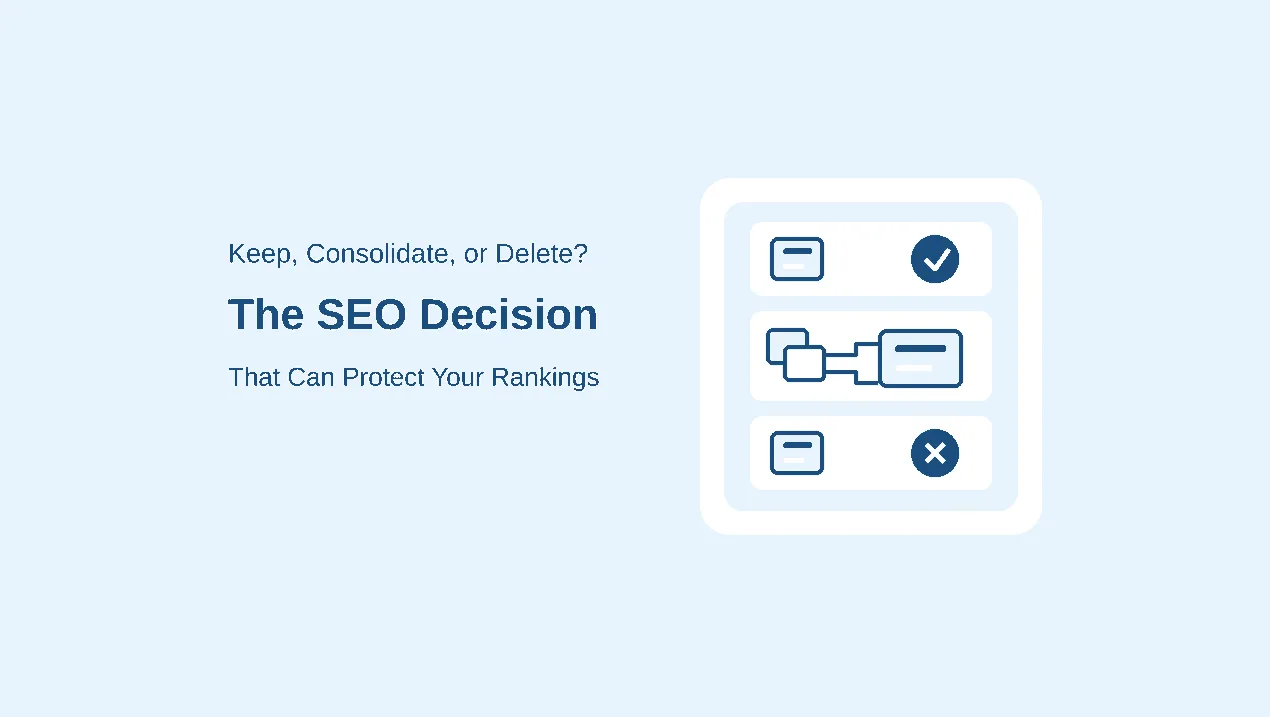
Content Audit
A decision framework for choosing between consolidating and deleting a flagged page.
Short answer
Choose consolidation only when the destination fits
Merge a page into another URL when they serve substantially the same need and a relevant destination can preserve useful content. Remove a page with a 404 or 410 when it no longer serves a purpose and no suitable replacement exists. Backlinks or traffic are reasons to investigate value, not permission to redirect visitors to an unrelated page. Retaining or improving the original URL may be the better answer.
Definition
Consolidation and deletion have different outcomes
Consolidation combines useful material at a chosen destination and redirects a retired URL to that relevant replacement. Deletion removes the content without substituting another page. A useful error page can help visitors navigate while the requested URL still returns a genuine 404 or 410.
Before either action, check organic and other traffic, conversions, backlinks, internal links, seasonal demand and the page’s role for existing users. A support page can remain valuable without substantial search traffic. An indexing or measurement problem can also make a useful page look inactive.
A rewrite changes the content of a page that still deserves its own URL. Canonicalisation identifies a preferred version of duplicate or near-duplicate content; it is not a substitute for deciding whether two genuinely different user needs should remain separate.
The framework
Four questions to review before retiring a URL
-
01
What value does the page provide?
Review a representative time period, including seasonality, in Search Console and analytics. Check conversions, earned backlinks and non-search use. No traffic in a short window does not establish no value.
-
02
Does another page satisfy the same intent?
Read both pages and compare the questions they answer. A shared topic or keyword alone does not prove that they compete. Use query and landing-page evidence where available.
-
03
Can the destination preserve useful material?
Choose the destination using relevance, existing performance, links and maintainability. Merge unique useful content before retiring the source, and resolve conflicting facts.
-
04
Would the redirect make sense to the visitor?
Require a genuinely equivalent replacement. If none exists, keep or improve a useful original page; otherwise return 404 or 410. Do not redirect to the homepage solely to retain backlinks.
Decision rule: Consolidation needs both a relevant destination and a reason to combine the pages. Backlinks, traffic or an overlapping topic alone do not satisfy both conditions.
Before assuming low value
Signals that often get misread as low value
A few patterns regularly get treated as evidence for removal when they are not, on their own, evidence of anything. Check for these before treating low or falling traffic as a verdict.
Seasonal or cyclical demand. A page tied to a specific time of year, event or buying cycle can show long stretches of low traffic between peaks. Review a full cycle, not a recent snapshot, before judging it inactive.
An internal-linking or structural role. A page with little direct search traffic can still support crawl paths, topical grouping or navigation for other pages. Check inbound internal links and what depends on the URL before removing it.
A recent publish date. A page that has not yet had time to be indexed, crawled repeatedly or ranked will often show low numbers regardless of its eventual value. Distinguish "new and unproven" from "reviewed and found wanting."
An indexing or tracking fault. Confirm the page is indexed and that analytics or tag configuration is working correctly before concluding that low reported traffic reflects low actual demand.
A common complication
When more than one page could be the destination
The framework above assumes a single clear destination exists. In practice, two or more existing pages can each plausibly absorb the retiring page's content. Choosing between them on relevance alone is not enough once more than one candidate qualifies.
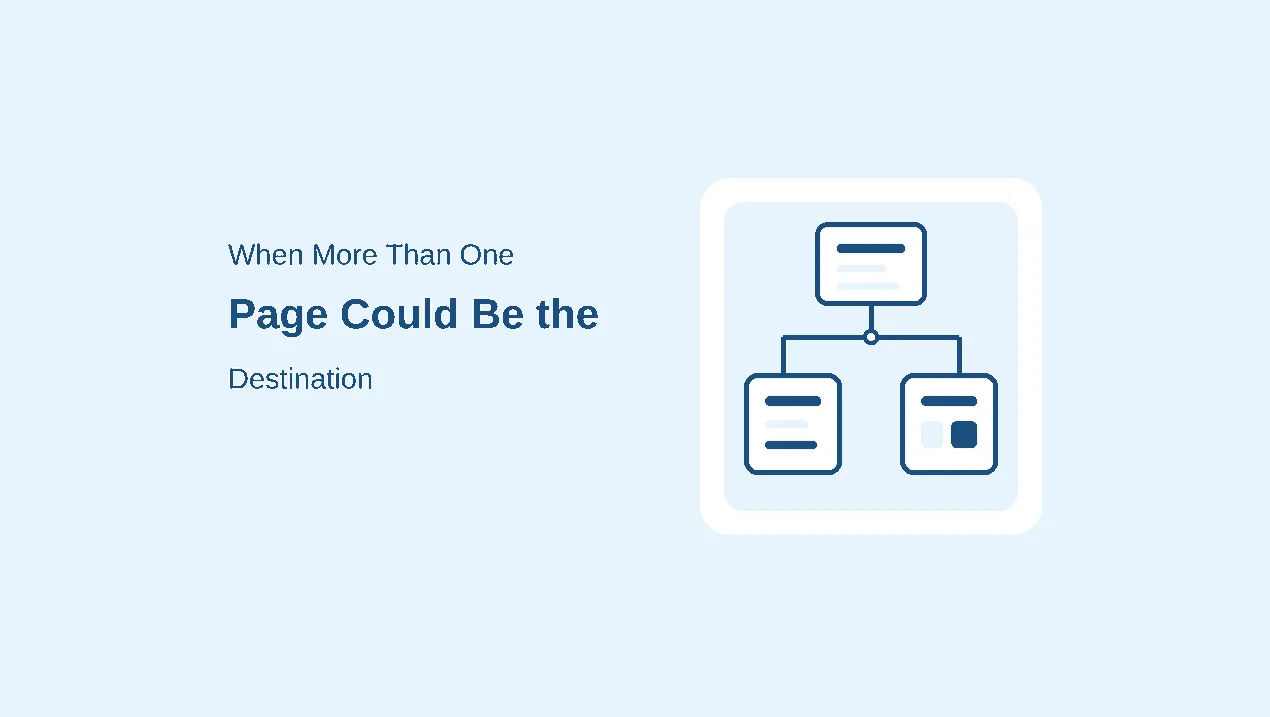
Compare the candidates on current performance (which one already ranks or converts better), maintainability (which one is easier to keep accurate and current going forward), and existing link equity (which one already holds more relevant backlinks or internal links). Favour the candidate that wins on most of these rather than the one that is simply closest in topic.
If two candidates are genuinely comparable and both would work, that itself may be a signal that the two candidates overlap with each other as well as with the page being retired, which is worth a separate look rather than a reason to pick arbitrarily.
Once the decision is made
Execute the chosen action and verify it
-
01
Record the decision and baseline
Save the old content, URL, destination if applicable, reason, date and relevant performance evidence. Keep a recovery copy before removing anything.
-
02
For consolidation, merge before redirecting
Publish the useful material at the chosen destination, then implement a direct permanent redirect, commonly 301. Confirm the destination returns 200 and represents the intended canonical page.
-
03
For deletion, return an honest status
Remove the content and return 404 or 410 when no replacement exists. Do not return a normal 200 response for a removed page, or use an irrelevant redirect just to avoid an error.
-
04
Update references and monitor
Update internal links to the surviving destination, remove retired URLs from the sitemap and check for redirect chains. Review indexing and performance after recrawling. Search Console’s Removals tool is temporary hiding, not a substitute for permanent removal.
Combine audit findings with performance evidence
Web Audit provides technical findings. Pair them with Search Console, analytics, backlink evidence and a manual intent review before retiring a URL. A thin-content or technical warning alone is not a deletion recommendation.
Common questions
FAQs
Should every deleted page redirect?
No. Redirect only when a suitable replacement satisfies the original visitor need. Otherwise, a genuine 404 or 410 is appropriate for removed content.
Is 410 always better than 404?
Both are accepted removal signals. Do not promise a specific deindexing speed; implement the status correctly and allow time for recrawling.
What if a page has backlinks but no relevant replacement?
Investigate retaining or improving the page if it still has value. If it must be removed and no equivalent destination exists, do not force an unrelated redirect for the backlinks.
Do similar keywords prove cannibalisation?
No. Compare intent, content and query-to-page performance. Related pages may serve different needs.
Can I delete a page because it has no organic visits?
Not on that evidence alone. Check seasonality, indexing, tracking, conversions and value to existing users.
Is the Search Console Removals tool permanent?
No. It temporarily hides a URL from results. A permanent outcome requires the appropriate change on the site.
Summary
Preserve useful content and visitor intent. Consolidate when a relevant destination justifies combining pages, retain useful distinct pages, and use 404 or 410 when removed content has no replacement. Record the decision, update references and verify the technical outcome without promising that all traffic or ranking signals will transfer.
For implementation details, see Google’s guidance on redirects and Google Search.
References
Sources and further reading
- Google Search CentralRedirects and Google Search
- Google Search CentralCanonicalisation methods
- GoogleRemovals tool
- Google Search CentralDiagnosing traffic drops
- SEO AnalyserWebsite content audit
- SEO AnalyserWeb Audit