FAQ Schema for AI Citations Does It Actually Help

 Oct 06,2026
 By SEO ANALYSER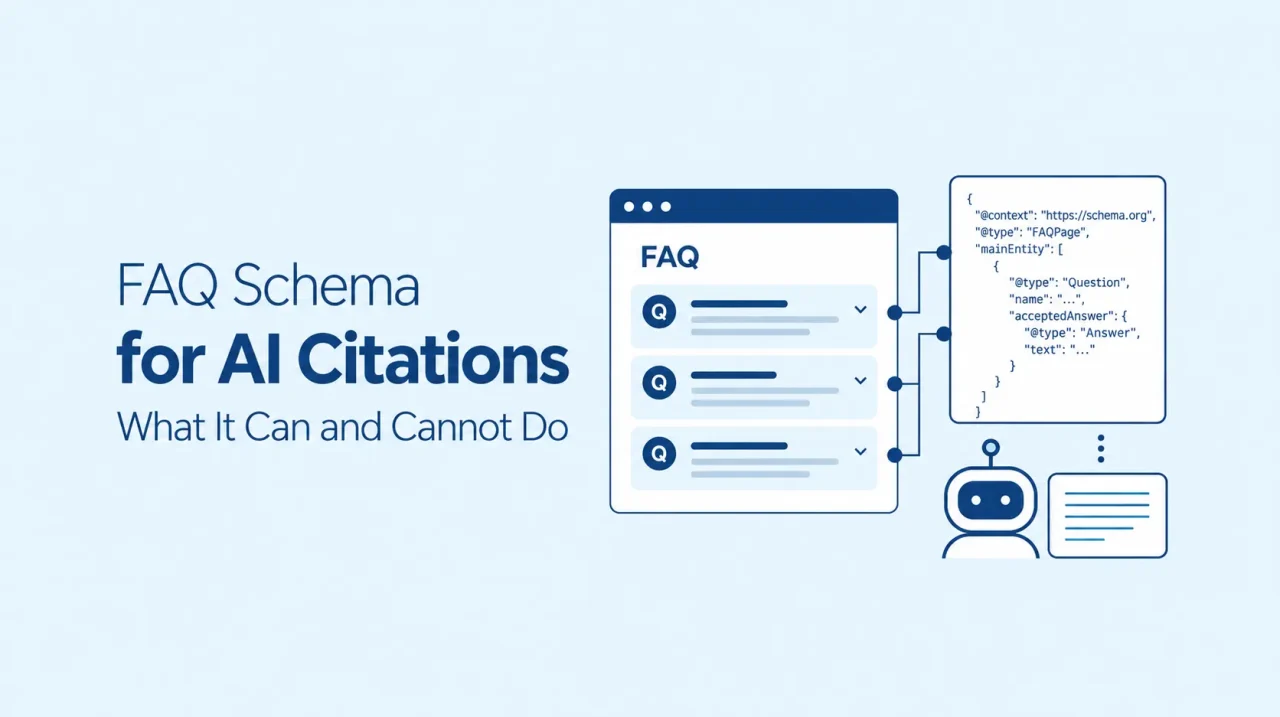
Structured Data
FAQ schema can make question-and-answer relationships explicit, but it is not a shortcut to an AI citation. This guide explains the useful role of FAQPage markup, the limits of the evidence, and a practical implementation workflow.
Short answer
FAQ schema improves clarity, not guaranteed citation selection
FAQPage markup can describe a visible, publisher-written FAQ in a standard machine-readable format. That can reduce structural ambiguity, but Google says no special schema is required for AI Overviews or AI Mode, and no major AI platform publishes a rule promising citations to pages with FAQPage markup.
FAQPage basics
What FAQPage schema actually describes
FAQPage is a Schema.org type for a page that presents one or more questions with answers supplied by the publisher. The markup identifies each question as a Question entity and connects it to an acceptedAnswer. Its job is descriptive: it tells a parser which text is the question and which text is the corresponding answer.
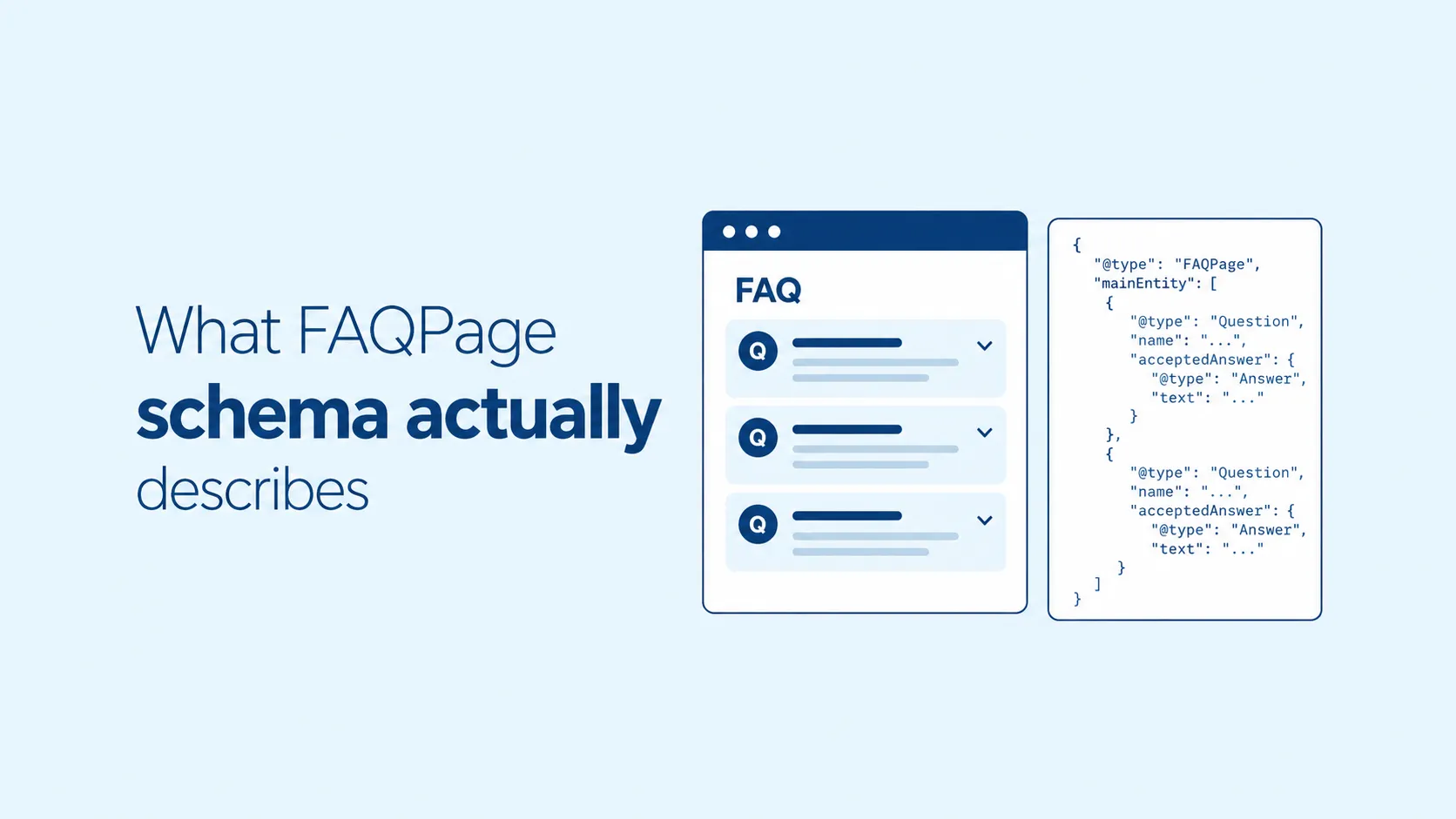
That model is narrower than many implementations suggest. A product page with two promotional headings is not automatically an FAQ, and a community thread where several people submit answers is not an FAQPage. Schema.org uses QAPage for pages centred on a question with user-submitted answers.
AI citations
What FAQ schema can and cannot do for AI answers
How FAQ schema can support AI-readable content
The strongest defensible benefit is explicit structure. When the visible page and JSON-LD agree, the markup provides a clear representation of the question, answer and page type. This can support interpretation by systems that consume structured data, but support is not the same as a ranking factor or a citation guarantee.
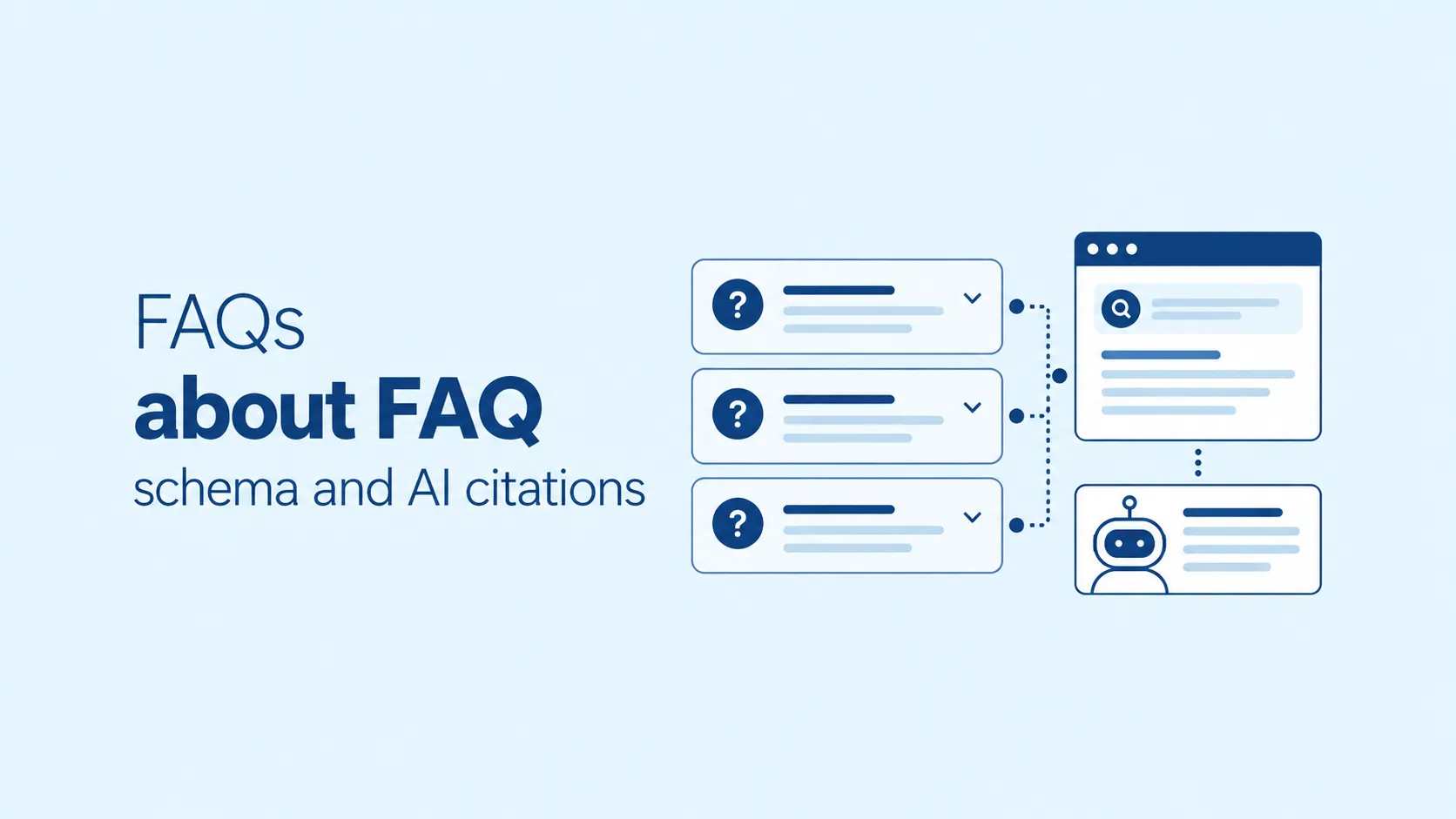
For Google's AI features, the published requirements remain the ordinary requirements for Search. A page needs to be indexed and eligible to appear with a snippet. Important information should be available as text, the page should be discoverable through internal links, and structured data should match what users can see. Google explicitly says there is no additional AI-specific schema requirement.
- Answer the question immediately, then add context, evidence or a useful qualification.
- Keep each answer self-contained so it still makes sense when extracted from the surrounding section.
- Use precise entities, dates, units and product names where ambiguity would change the meaning.
- Link factual claims to primary or authoritative sources instead of relying on unsupported assertions.
- Keep the visible answer and structured answer materially equivalent.
What FAQ schema cannot do
FAQ schema cannot make weak content authoritative, force a crawler to index a page, guarantee a rich result, or compel an AI system to cite the URL. It also cannot prove that a statement is correct; it only labels the relationship between pieces of information.
Citation selection can depend on the query, the available sources, freshness, corroboration, system design and platform-specific retrieval. Those systems are not controlled by a single JSON-LD block. Treat claims such as "add FAQ schema and get cited" as unverified unless the claimant provides a reproducible method and separates correlation from causation.
FAQ schema versus a well-structured FAQ
| Layer | What it contributes | What it does not prove |
|---|---|---|
| Visible FAQ content | Useful answers, evidence and context for readers | That a platform will select or cite the page |
| HTML structure | Headings, paragraphs and links that expose the reading order | That the content is accurate or distinctive |
| FAQPage JSON-LD | An explicit machine-readable question-and-answer relationship | A ranking boost, rich result or AI citation |
| Measurement | Observed mentions, citations and answer inclusion over time | That schema alone caused any change |
Implementation
A clean JSON-LD example and a responsible rollout
A clean JSON-LD example
The following example is deliberately small. In production, use the exact visible wording or a materially equivalent version, and update both versions together.
<script type="application/ld+json">
{
  "@context": "https://schema.org",
  "@type": "FAQPage",
  "mainEntity": [{
    "@type": "Question",
    "name": "Does FAQ schema guarantee AI citations?",
    "acceptedAnswer": {
      "@type": "Answer",
      "text": "No. It can clarify question-and-answer structure, but it does not guarantee selection or citation in AI-generated results."
    }
  }]
}
</script>
How to implement FAQ schema responsibly
-
01
Choose a real use case
Add questions because they remove friction for readers, not because a tool recommends filling a schema quota.
-
02
Write the visible answer first
Lead with the answer, keep the scope narrow and add a source where the claim requires verification.
-
03
Map to Question and acceptedAnswer
Map each visible item to Question and acceptedAnswer. Do not mark up hidden, unrelated or fabricated questions.
-
04
Place JSON-LD on the canonical page
Keep it aligned with the page's current content.
-
05
Validate the syntax
A JSON validator or Schema.org-aware validator can catch malformed JSON, missing objects and incorrect nesting.
-
06
Recheck after edits
Content and markup drift is a common source of avoidable inconsistency.
Validation
Validate the markup, then measure the outcome
What to test after publishing
A successful validation means the syntax and object relationships are understandable; it does not mean a search or AI feature will display the content. Check the rendered page, the page source and the canonical URL. Confirm that every marked-up question is visible, every answer is complete, and no CMS component outputs a second conflicting FAQPage block.
- Test the JSON for parsing errors and correct nesting.
- Inspect the final rendered HTML, not only the editor preview.
- Check that canonicalisation, robots rules and noindex settings do not contradict the publication goal.
- Review mobile presentation and keyboard access if the FAQ uses accordions.
- Record the publication date, page version and tracked prompt set before measuring change.
How to measure whether the page becomes more visible
Do not judge success from schema validation alone. Establish a stable set of questions the page genuinely answers, record whether the brand or URL is mentioned or cited on the platforms relevant to your audience, and compare the pattern over time. Keep platform results separate because citation behaviour differs.
If visibility improves after several simultaneous changes, describe the result honestly: the page changed and performance moved. Without a controlled test, do not attribute the entire movement to FAQ schema. Review query coverage, content revisions, crawl state, links and source quality alongside the markup.
Where SEO Analyser fits
SEO Analyser's AI Visibility module tracks outcome signals such as citation presence and answer inclusion. That makes structured data one diagnostic input rather than the conclusion: use the Structured Data view to find mismatches, then use repeated visibility measurement to see what actually changes.
Common questions
FAQs
Does FAQ schema guarantee a citation in ChatGPT, AI Overviews or Perplexity?
No. FAQPage can make the structure explicit, but no public rule guarantees selection or citation because the markup is present.
Is FAQ schema still useful after Google removed FAQ rich results?
It can still be useful as accurate structured description when a page genuinely contains publisher-written FAQs. The reason is structural clarity, not additional Google result space.
Should the JSON-LD answer be shorter than the visible answer?
It may be more concise, but it must remain materially equivalent. Do not remove qualifications that change the meaning or add claims that users cannot see.
Should every article include FAQPage markup?
No. Add it only when a distinct FAQ section serves the reader and matches the page intent. A forced FAQ can duplicate the main content and make the page less focused.
Can structured data compensate for thin or unsupported content?
No. Markup describes content; it does not supply evidence, originality, authority or usefulness.
Summary
Use FAQ schema for clarity, then measure the result. FAQPage markup can express a genuine question-and-answer structure, but it does not guarantee rankings, rich results or AI citations. Build the visible FAQ for readers first, keep the markup accurate, validate the published output and measure citations with a stable prompt set. The most credible strategy is useful content plus sound technical foundations and honest observation, not a promise that one schema type unlocks AI visibility.
References
Sources and further reading
- Google Search CentralAI features and your website
- Google Search CentralFAQPage structured data (includes the May 2026 removal notice)
- Schema.orgFAQPage
- Schema.orgQAPage
- SEO AnalyserAI Visibility