

AEO vs SEO vs GEO

 Aug 15,2026
 By SEO ANALYSER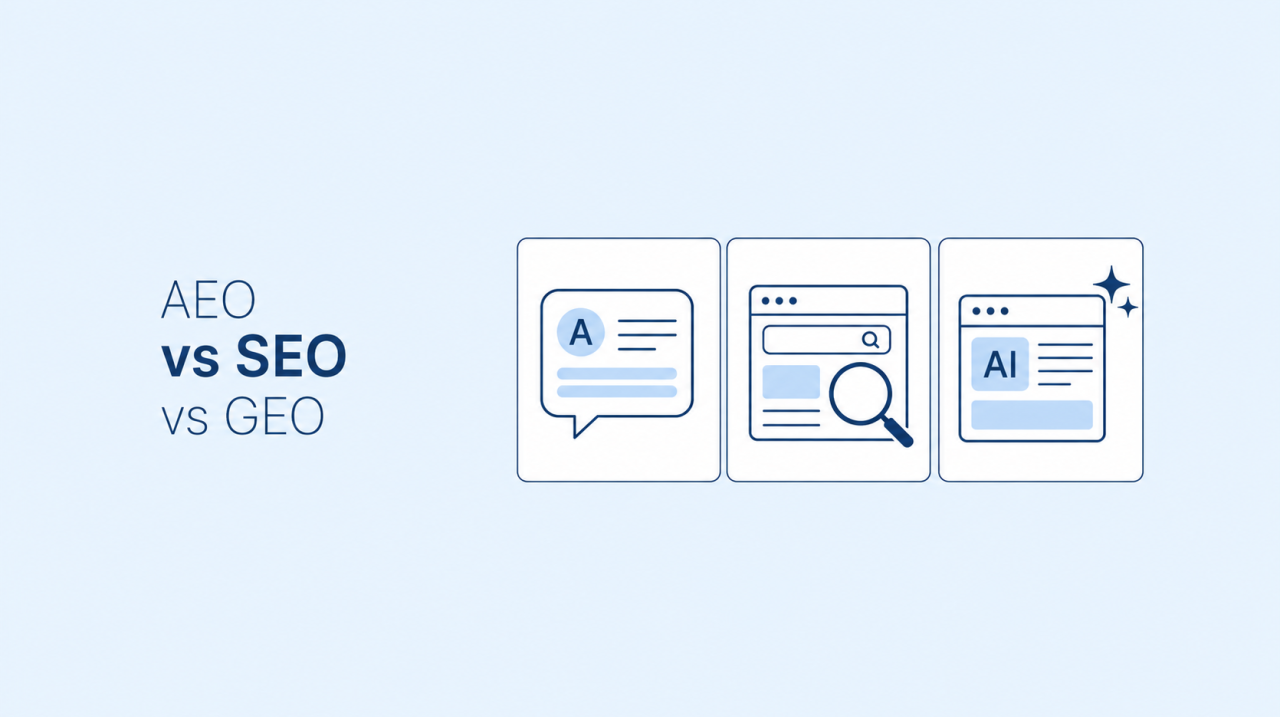
AEO · SEO · GEO
More search results open with AI summaries; this piece breaks down AEO vs SEO vs GEO practically.
Short answer
SEO, AEO and GEO aim at different result formats
SEO focuses on ranking web pages in traditional search results. AEO focuses on getting content selected as a direct answer, whether that is a featured snippet or a voice response. GEO extends that same goal to summaries produced by large language models. They overlap heavily but aim at different result formats.
Context
Why AEO, SEO and GEO matter now
More search results now open with an AI-generated summary before a single traditional listing appears. That shift is why terms like answer engine optimisation, generative engine optimisation, and voice search have moved from niche jargon into everyday marketing conversations. For anyone running a campaign in 2025, understanding where these approaches overlap and where they genuinely differ is no longer optional.
This piece breaks down AEO vs SEO vs GEO in practical terms: what each one actually does, where the lines blur, and how to build a strategy that accounts for all three.
Definition
What is answer engine optimisation?
Answer engine optimisation is the practice of shaping content so that search systems can extract a clear, direct answer from it, rather than simply ranking the page. Instead of asking "where does this page sit on page one," AEO asks "can a system pull a usable answer straight out of this content."
This matters because a growing share of queries never produce a click at all. A user asks a question, gets an answer inside the results page itself, and moves on. Voice assistants work the same way: they read out one answer, not a list of ten blue links. Content written for AEO tends to be structured around conversational queries, with the answer stated early and supporting detail following after. Pages that bury the answer under several paragraphs of introduction are far less likely to be pulled into AI-generated answers, regardless of how well they otherwise rank.
Comparison
AEO vs SEO vs GEO: what actually separates them
The confusion around these three terms usually comes from the fact that they share the same raw material: well-structured, relevant content. Where they differ is in the target output and the system doing the selecting.
SEO is the broadest of the three. It covers everything that helps a page rank in traditional organic results, including technical health, backlinks, on-page relevance, and page experience. AEO vs SEO is not really an either-or comparison; AEO sits inside the broader SEO discipline, but narrows the goal to a single outcome: being chosen as the direct answer, usually inside a snippet, a knowledge panel, or a voice response.
GEO, or generative engine optimisation, is the newest of the three and applies specifically to how content gets pulled into AI-generated summaries produced by tools like AI Overviews or chat-based assistants. It shares AEO's focus on clear, extractable answers, but it also cares about how a brand or source gets cited within a longer, synthesised response rather than a single short snippet.
To put that in context, a comparison table makes the distinctions easier to hold in mind:
| Approach | Primary Goal | Typical Result Format |
|---|---|---|
| SEO | Rank the page well in organic results | Standard search listing |
| AEO | Be selected as the direct answer | Featured snippet, voice response |
| GEO | Be cited within an AI-generated summary | AI Overview, chat-based answer |
Consider a local plumbing business publishing a page titled "How much does a hot water system replacement cost." Written purely for SEO, the page might rank on page one after months of link building. Written with AEO in mind, the same page opens with a direct cost range in the first two sentences, making it a stronger candidate for a snippet. Written with GEO in mind, the business also structures the content with clear headings and factual statements that an AI summary tool can lift and attribute, which can influence whether the brand gets named inside a generated answer rather than just linked to it. None of these approaches replace the others; they layer on top of the same page, and that GEO layer is usually what decides whether you rank in chatgpt for the query.
Selection signals
How answer engines decide what to surface
Answer engines rely on natural language processing to match a question to the clearest available response, and that process depends heavily on how well a page signals meaning. This is where semantic search comes in: systems are matching concepts and intent, not just exact keyword strings, so a page needs to demonstrate topical clarity rather than keyword repetition.
Structured data plays a supporting role here rather than a decisive one. Adding schema markup such as FAQ or HowTo markup helps search engines understand the structure of a page, which can make it easier for a system to identify a self-contained answer. It does not guarantee selection on its own.
Formatting also matters more than most site owners expect. Short, direct paragraphs, clear headings that mirror likely questions, and answers placed near the top of a section all give an answer engine less work to do when deciding what to extract. Pages that rely on long, meandering explanations tend to get skipped over, even when the underlying information is accurate.
Strategy
Building an AEO strategy without abandoning SEO
An effective AEO strategy does not replace existing SEO work; it adds a layer on top of it. The technical foundations, page speed, crawlability, internal linking, still matter, because an answer engine still needs to find and understand the page before it can extract anything from it. Running an AI audit of those foundations first keeps answer-focused rewrites from landing on pages that cannot be retrieved cleanly.
The practical difference shows up in how content gets written. Teams building for AEO usually start by mapping the specific questions their audience asks, then writing a direct, self-contained answer for each one before adding supporting context. This depends on genuinely understanding search intent rather than guessing at phrasing. A page that answers the literal question in the first sentence, then expands with detail, examples, and nuance, tends to perform better across both traditional rankings and answer-engine selection.
Bridge
Featured snippet optimisation as a bridge between SEO and AEO
Featured snippet optimisation sits comfortably between traditional SEO and full AEO, because a snippet is still tied to a ranked page rather than a fully generated answer. Getting selected usually means a page is already ranking within the top few positions, then wins the snippet by presenting a concise, well-formatted answer that Google can lift directly.
Common formats that tend to win snippets include a short paragraph of forty to sixty words directly answering a question, a numbered list for a process, or a simple table for comparative data. This matters partly because of zero-click searches, where a user gets their answer without visiting any site at all. That trade-off is worth acknowledging: winning a snippet can raise visibility and brand recognition, even where it does not always translate into a click.
Voice
Voice search SEO and where it fits
Voice search SEO shares most of its groundwork with AEO, since voice assistants pull from the same pool of snippets and structured answers. The main difference is query phrasing: voice queries tend to be longer and more conversational than typed searches, closer to how someone would actually ask a question aloud.
That said, treating voice search as a fully separate discipline is usually unnecessary. Content written clearly for AEO, with direct answers to natural-language questions, tends to perform reasonably well in voice contexts without any additional rework.
Measurement
Measuring whether your AEO efforts are working
Measuring AEO success is harder than measuring standard rankings, mainly because a page can be selected as an answer without generating a click or any obvious referral data. Rank tracking tools can flag whether a page holds a featured snippet position, which is a useful proxy, but it is not the full picture.
Worth noting here: a drop in organic traffic alongside a stable or improving snippet position does not necessarily signal a problem. It may reflect more users getting their answer directly in the results. Watching ranking signals over time, alongside branded search volume, gives a more balanced read than traffic alone. Teams that also measure ai visibility across snippets and AI summaries see whether answer selection is rising even when clicks fall.
Pitfalls
Common mistakes when optimising for answer engines
A few recurring mistakes show up across teams attempting AEO for the first time, and most of them are fixable without a full content rebuild:
- Burying the direct answer several paragraphs into the content instead of stating it early.
- Writing headings as vague labels rather than as the actual questions users ask.
- Skipping structured data entirely, or applying it inconsistently across similar pages.
- Treating GEO, AEO, and traditional SEO as competing priorities instead of layered ones.
- Ignoring citation-worthy content, meaning clear facts, definitions, and figures that a system can extract with confidence.
That said, your mileage may vary depending on the query type and industry; some topics simply generate more snippet or AI-summary opportunities than others.
Where SEO Analyser fits
SEO Analyser includes a module named AI Visibility that helps you review how answer-engine and generative-summary signals sit alongside ordinary search checks while you compare AEO, SEO and GEO work.
Common questions
FAQs
What is the main difference between AEO and SEO?
SEO aims to rank a page well in traditional organic results, while answer engine optimisation aims to get that same content selected as a direct answer, such as a featured snippet or voice response. AEO depends on solid SEO foundations but narrows the goal to a single extractable answer rather than overall page ranking.
Does GEO replace the need for traditional SEO?
No. Generative engine optimisation depends on the same technical and content foundations as SEO. It adds a focus on how AI-generated summaries cite or reference a source, but a page still needs to be crawlable, relevant, and well-structured before any of that can happen.
How does featured snippet optimisation actually work?
It usually involves writing a concise, self-contained answer near the top of a ranking page, formatted as a short paragraph, list, or table depending on the question type. Search engines then decide whether to lift that section into a snippet, which depends on relevance, clarity, and existing ranking position.
Is voice search SEO worth treating as a separate strategy?
Generally, no. Voice search SEO relies on the same clear, question-based content that supports AEO more broadly. The main adjustment is accounting for longer, more conversational phrasing, rather than building an entirely separate content plan.
How long does it take to see results from an AEO strategy?
Results vary depending on how competitive the query is and how much rework the existing content needs. Some pages gain snippet visibility within weeks of restructuring; others take longer, particularly where structured data and content clarity both need attention at the same time.
Can a page be optimised for SEO, AEO, and GEO at the same time?
Yes, and in most cases it should be. These approaches share the same underlying content, so writing clear, well-structured answers with supporting technical SEO in place tends to support all three outcomes rather than requiring separate content for each.
Summary
AEO, SEO, and GEO are not competing strategies, they are layered ones built on the same foundation of clear, well-structured content. Traditional SEO gets a page found and ranked, answer engine optimisation shapes that content so it can be extracted as a direct answer, and GEO extends the same discipline to AI-generated summaries that cite or reference a source. Treating any one of these as optional usually means missing a growing share of how people now find answers.
The practical path forward is straightforward: keep the technical SEO groundwork solid, write content that answers real questions early and clearly, and add structured data where it genuinely helps. Measured this way, an AEO strategy becomes an extension of good SEO practice rather than a separate project competing for the same resources.
References
Sources and further reading
- SEO AnalyserHow to show up on ChatGPT, Gemini and Perplexity
- SEO AnalyserHow to rank in ChatGPT
- SEO AnalyserAI search audit
- SEO AnalyserChatGPT for AI writing, AI SEO and content automation
- SEO AnalyserHow to measure AI visibility
- SEO AnalyserWhy AI cites some businesses and ignores others
- SEO AnalyserAI Visibility


